

What Is Segment (Group) Streetlight Control
Segment control, also known as group control, is a centralized method of managing street lighting through a controller installed inside an electrical cabinet.
Instead of communicating with each pole individually, the controller supervises the entire electrical segment—including feeder lines, contactors, protection devices, meters, and cabinet-level sensors.
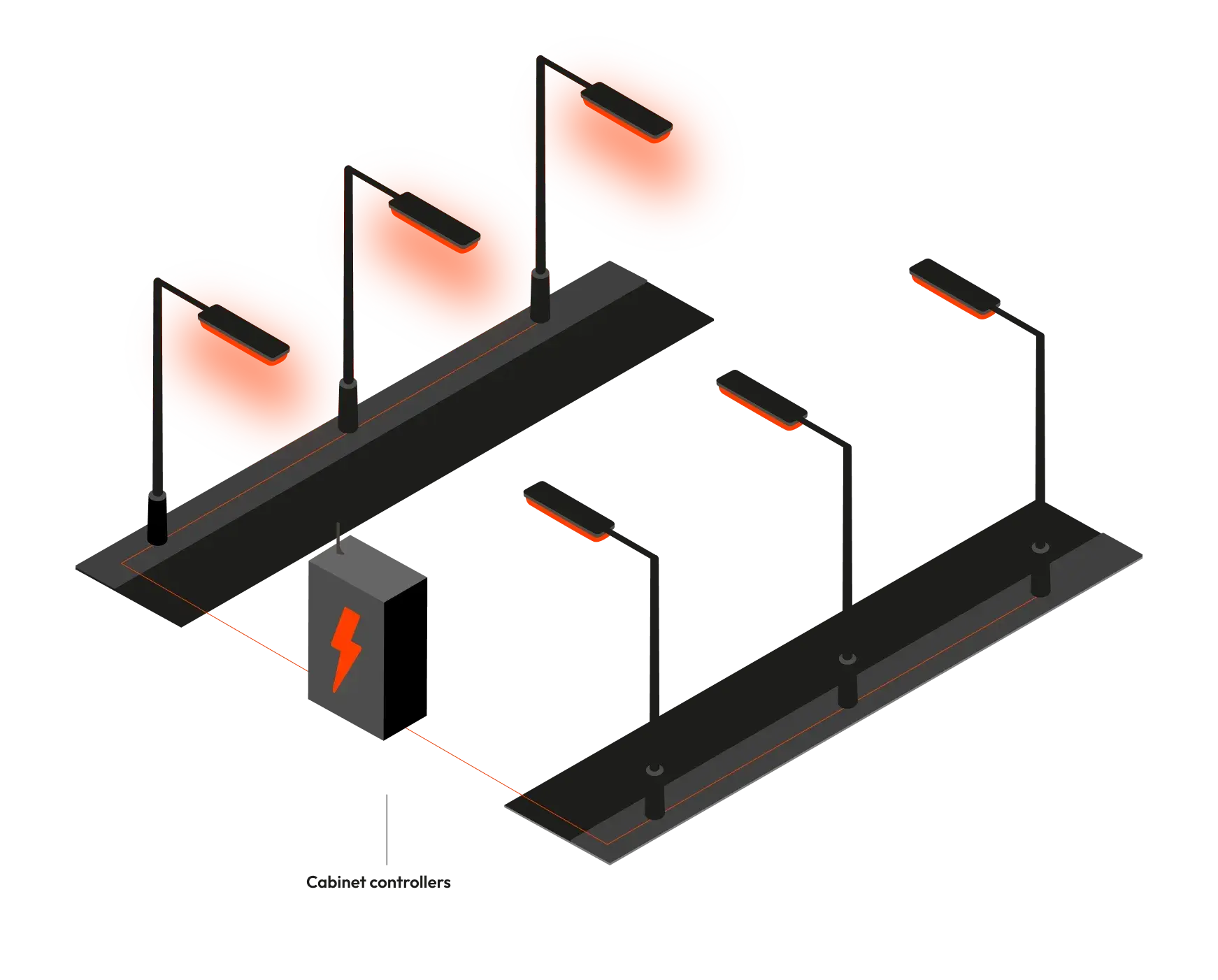
A segment controller operates as the primary control and monitoring point for:
- incoming power,
- switching and protection equipment,
- electrical loads and lighting groups,
- voltage and current measurement channels,
- auxiliary sensors and third-party interfaces.
This architecture is widely used in cities and industrial areas where reliability, simplicity, and predictable maintenance are critical.
Core Functions of a Segment Controller
1. Feeder Line Switching and Protection
The controller manages magnetic contactors or solid-state relays that switch entire lighting groups. It can also interact with protection devices such as circuit breakers or fuses.
2. Voltage and Current Monitoring
Continuous measurement of electrical parameters provides:
- feeder voltage presence,
- phase loss detection,
- overloads or under-voltage conditions,
- unbalanced or abnormal current flows.
These diagnostics cover the entire lighting group, not just individual luminaires.
3. Integration with Meters and Sensors
Segment controllers typically support:
- RS-485 (Modbus) for energy meters,
- CAN bus for cabinet or protection modules,
- internal or external sensors (temperature, door switch, smoke, humidity).
4. Remote Access and Control
Most systems provide connectivity via:
- GSM/LTE
- Ethernet
Remote access enables:
- schedule updates,
- event log retrieval,
- on-demand switching,
- firmware updates,
- alarm and diagnostic collection.
5. Centralized Scheduling
Controllers execute predefined or dynamic schedules based on:
- astronomical timers,
- real-time clocks,
- sensor inputs,
- or higher-level Smart City platforms.
Why Cities Still Prefer Segment Control
Segment control remains one of the most common architectures for roadway lighting because it provides several operational advantages.
High Reliability
One protected controller inside a cabinet is easier to secure, maintain, and replace than hundreds of pole-mounted devices exposed to weather and vandalism.
Clear, Centralized Diagnostics
Operators gain visibility into the overall feeder condition:
- voltage presence,
- contactor status,
- phase failures,
- overloads,
- alternating operation patterns. This simplifies fault localization and speeds up maintenance workflows.Cost Efficiency (Lower CAPEX)
A single controller per cabinet is significantly more cost-efficient than deploying individual pole-level controllers across an entire street or district.
Scalable Architecture
Segment control provides a stable foundation for:
- adding monitoring expansion modules (e.g., MultiConnect, PowerTrack, HighVoltRelay),
- upgrading to individual control later by layering PLC or RF nodes on top of the existing cabinet infrastructure.
No redesign of feeder wiring is required.
Typical System Architecture
A segment control deployment generally includes:
- Cabinet controller (main logic and communication unit),
- Magnetic or solid-state contactors,
- Energy meter (Modbus / RS-485),
- Protection devices (breakers, fuses, RCDs),
- Monitoring modules (voltage, current, leakage detection),
- Cabinet sensors (door, temperature, fire, environment),
- Connectivity module (GSM/LTE, Ethernet),
- Smart City or CMS software (central monitoring and scheduling).
Advantages and Limitations
Advantages:
- Robust and predictable operation,
- Low infrastructure cost,
- Easy integration with existing cabinets,
- Fast fault detection,
- Suitable for industrial and municipal networks.
Limitations:
- No per-luminaire dimming or diagnostics,
- Requires protected cabinet space,
- Limited granularity compared to individual NEMA/Zhaga nodes.
Most cities use hybrid systems where segment controllers coexist with individual control nodes for critical areas.
Comparison: Segment Control vs Individual Control
| Feature | Segment control | Individual control |
| Granularity | Group-level | Per-luminaire |
| Diagnostics | Cabinet/feeder | Pole-level |
| Cost | Low | Higher |
| Installation | Simple | Many devices |
| Communication | Local (cabinet) | PLC, RF, GSM |
| Upgrade path | Easy to hybrid | Already granular |
Use Cases
Segment control is ideal for:
- highways and long feeder lines,
- industrial zones,
- low-maintenance areas,
- cost-sensitive deployments,
- mixed networks with partial individual control,
- regions with harsh weather or vandalism risk.
In practice, selecting a segment control approach depends on cabinet configuration, control requirements, and system architecture.
A more detailed overview of how to choose a segment streetlight controller is available here