

Role of Street Lighting in Smart City Infrastructure
Street lighting plays a foundational role in modern Smart City ecosystems.
Due to its dense distribution, existing power supply, and elevated line of sight, lighting infrastructure is widely used as a physical backbone for urban IoT systems.
Smart City–ready lighting control extends beyond illumination management and includes:
- real-time telemetry from lighting nodes and cabinets,
- multi-sensor data acquisition,
- integration with municipal platforms,
- open data exchange via standardized APIs,
- and support for third-party IoT services.
This page describes how street lighting integrates into Smart City architectures, which data flows are involved, what standards are used, and how sensor-based applications extend functionality beyond lighting.
Role of Street Lighting in Smart City Infrastructure
Lighting poles are uniquely positioned to act as Smart City edge nodes, because they:
- exist every 25–50 meters,
- have stable power supply,
- provide elevated installation height,
- support networked electronic controllers,
- host multiple sensors with minimal deployment cost.
As a result, streetlights serve as:
- lighting endpoints,
- communication relay points,
- environmental sensing locations,
- urban telemetry collection nodes,
- micro-edge compute units,
- integration points for city services.
System Architecture
A Smart City–ready street lighting system typically includes the following layers:
Field Layer (Edge Devices)
- Individual lighting nodes (NEMA, Zhaga D4i, in-luminaire controllers).
- Cabinet/segment controllers.
- Sensors (motion, traffic, daylight, environmental, meteo).
- Communication modules (PLC, RF, GSM/LTE)
Network Layer
- RF mesh or sub-GHz radio.
- PLC distribution networks.
- Cellular IoT (GSM/LTE/Cat-M1/NB-IoT).
- Fiber/Ethernet backhaul (where available).
Platform Layer (Lighting CMS / SCADA)
- Configuration and asset management.
- Scheduling and dimming profiles.
- Telemetry aggregation.
- Alarm flow and event processing.
- Trend analytics.
- Integration APIs.
Integration Layer
- Smart City platforms (FIWARE, Cisco Kinetic, Interact, Telensa, EXEDRA).
- Municipal control rooms.
- Open data hubs.
- Third-party applications (traffic control, safety, environmental dashboards).
Data & Telemetry in Smart City Lighting
Lighting systems generate continuous telemetry that municipalities can use for operational and analytical purposes.
Electrical and Operational Data
- Input voltage.
- Current per luminaire or feeder.
- Power factor.
- Energy consumption (metering or D4i data).
- Luminaire temperature.
- Driver status and fault codes.
- Runtime hours.
Network Data
- Signal strength (RSSI for RF, RSRP for GSM).
- Node connectivity status.
- Packet loss.
- Cabinet communication status.
Environmental and Urban Data
- Motion sensors → activity-based dimming & occupancy patterns.
- Traffic sensors → vehicle flow, density, and speed (for adaptive lighting rules).
- Daylight sensors → real-time lux correction and ON/OFF override.
- Air quality sensors → PM2.5, PM10, NO₂, VOC.
- Noise sensors → sound intensity for urban safety analytics.
- Meteo sensors → temperature, humidity, precipitation, wind, fog.
- Vibration/tilt → pole stability and asset management.
- Vision sensors → traffic analytics, parking detection, pedestrian counting.
Lighting poles thus become micro measurement stations for Smart City services.
Standards and Interoperability
Smart City lighting follows several key standards:
- TALQ Smart City Protocol. Defines a standardized API and data model for CMS-to-platform communication.
- Zhaga Book 18 / D4i. Defines interoperable connectors and driver-level data exchange for luminaires.
- IEC 62386 (DALI). Defines communication over DALI/D4i inside luminaires.
- 5.4 IPv6-based IoT frameworks. Used in RF mesh systems and modern cellular IoT networks.
Standardization ensures:
- vendor-agnostic control,
- future upgrades without replacing the whole infrastructure,
- compatibility with third-party systems.
Smart City Applications Enabled by Lighting Control
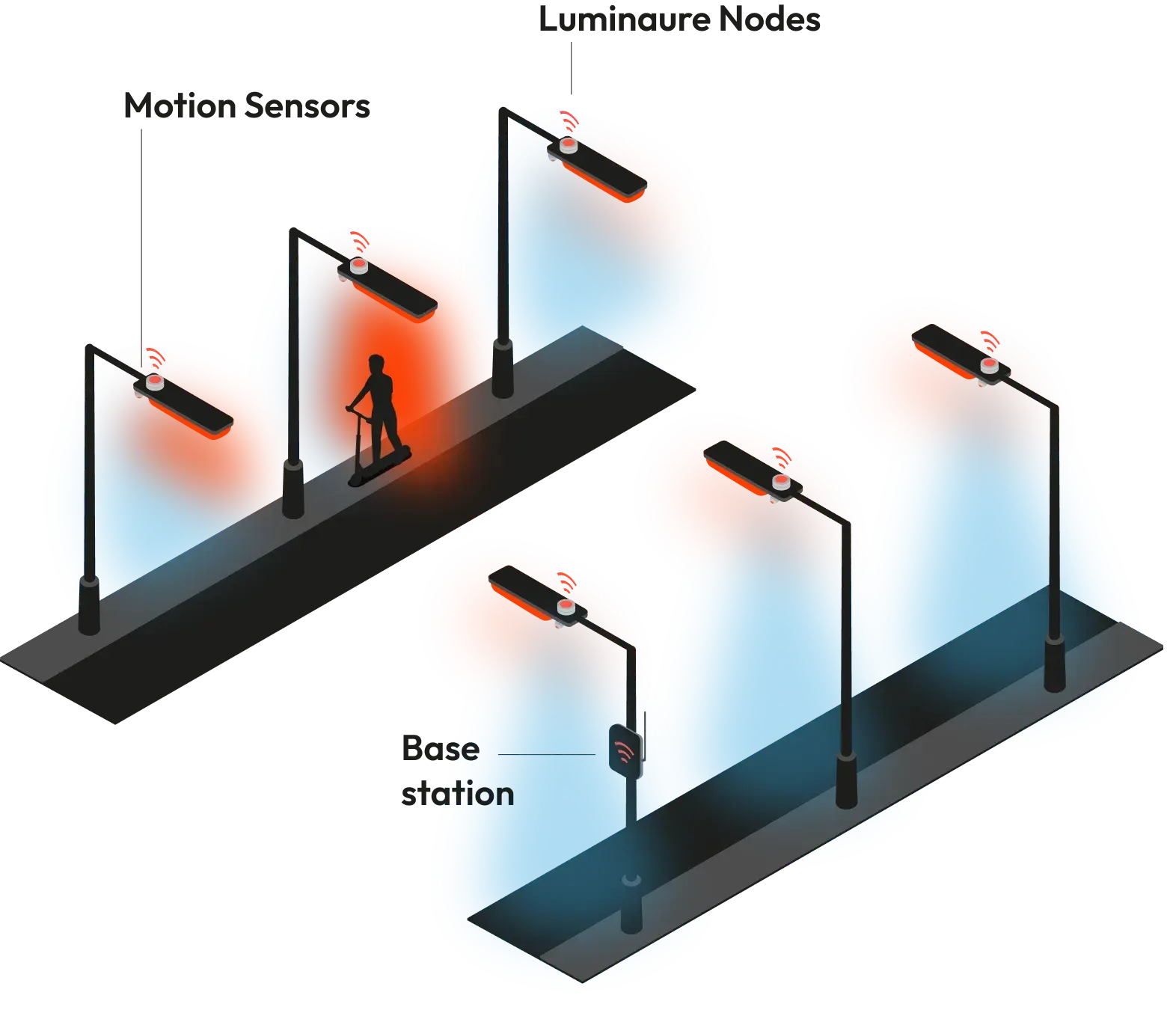
Automatic lighting control becomes the backbone for wider IoT applications:
- Adaptive Lighting. Adjusts light levels using motion, traffic, and daylight data.
- Urban Safety & Navigation:
- brighter crossing zones upon pedestrian detection,
- emergency-level lighting on demand,
- incident response illumination. - Environmental Monitoring:
- real-time air quality,
- microclimate mapping,
- noise pollution tracking. - Traffic & Mobility Analytics:
- smart intersections,
- parking detection,
- vehicle counting,
- optimizing dimming schedules based on traffic flows. - Infrastructure Management:
- pole condition tracking,
- collision detection,
- predictive maintenance using sensor data. - Energy and Sustainability Planning. Lighting data informs:
- carbon reduction KPIs,
- city-wide efficiency reports,
- renewable adoption strategies.
Integration with City Platforms
Lighting CMS platforms integrate with municipal systems using:
- REST or MQTT APIs,
- TALQ-compliant interfaces,
- FIWARE NGSI data models,
- OpenAPI specifications,
- or custom bidirectional protocols.
This enables:
- unified dashboards,
- real-time alerts,
- cross-department data exchange,
- analytics-driven urban planning.
Why Street Lighting Is Key to Smart City Development
Street lighting is often the first Smart City infrastructure upgrade because:
- poles already cover the entire city grid,
- power supply exists everywhere,
- maintenance teams are trained to service them,
- costs are significantly lower than deploying dedicated IoT poles,
- they support multiple sensors with minimal retrofitting.
Lighting networks provide a ready-made technological foundation for scalable Smart City deployments.
Turning street lighting into a genuine Smart City platform requires careful planning — from control architecture and sensor selection to open API integration. For a practical step-by-step breakdown, see our guide: Smart City Lighting Solutions: Architecture, Sensors, and Deployment