

What Is Individual Wireless Street Lighting Control
Individual wireless control is a communication architecture in which each luminaire is equipped with a radio or cellular communication module, enabling per-luminaire switching, dimming, diagnostics, and telemetry without relying on cabinet-based control.
Unlike segment control, which manages entire feeders, individual wireless control provides:
- granular visibility,
- per-node fault detection,
- independent dimming levels,
- flexible lighting profiles,
- remote access to each lighting point.
Wireless control is typically implemented using sub-GHz RF (868/915 MHz) or cellular GSM/LTE IoT modules, depending on project conditions and urban density.
RF-Based Individual Control (Sub-GHz Radio Control)
In RF-based systems, each luminaire is equipped with a sub-GHz radio module, creating a wireless communication network between nodes and a central base station.
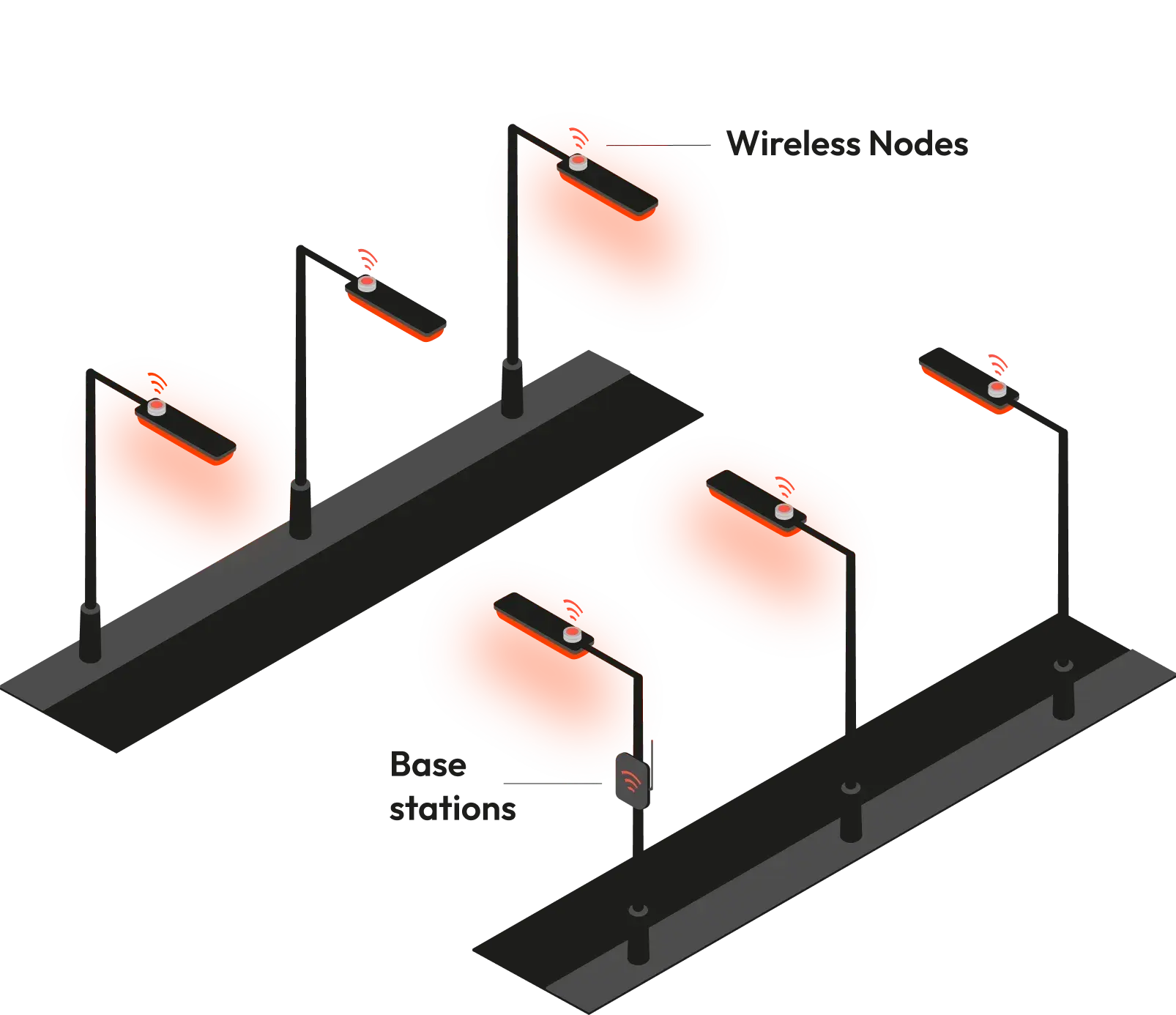
DITRA’s implementation of this approach uses a proprietary radio protocol known as LiWAVE, optimized specifically for outdoor lighting infrastructure.
How RF Control Works
- Operates on license-free sub-GHz bands (868 or 915 MHz).
- The central base station manages communication with all nodes within range.
- Nodes support remote ON/OFF, dimming, and diagnostics.
- The base station connects to the central software platform via GSM or Ethernet.
Technical Characteristics
- Long-range sub-GHz propagation suitable for outdoor environments.
- Resistance to building shadows and obstacles.
- Lower latency than cellular communication.
- Efficient for distributed lighting systems.
Recommended Use Cases
RF control is particularly suitable when:
- luminaires are powered from decentralized sources,
- the environment has low high-rise building density,
- typical scenarios include intercity roads, bridges, suburban areas, or coastal zones.
DITRA's implementation uses a proprietary sub-GHz protocol LiWAVE. See how it's deployed in practice: Radio-based Streetlight Individual Control Solution
GSM-Based Individual Control (Cellular IoT Control)
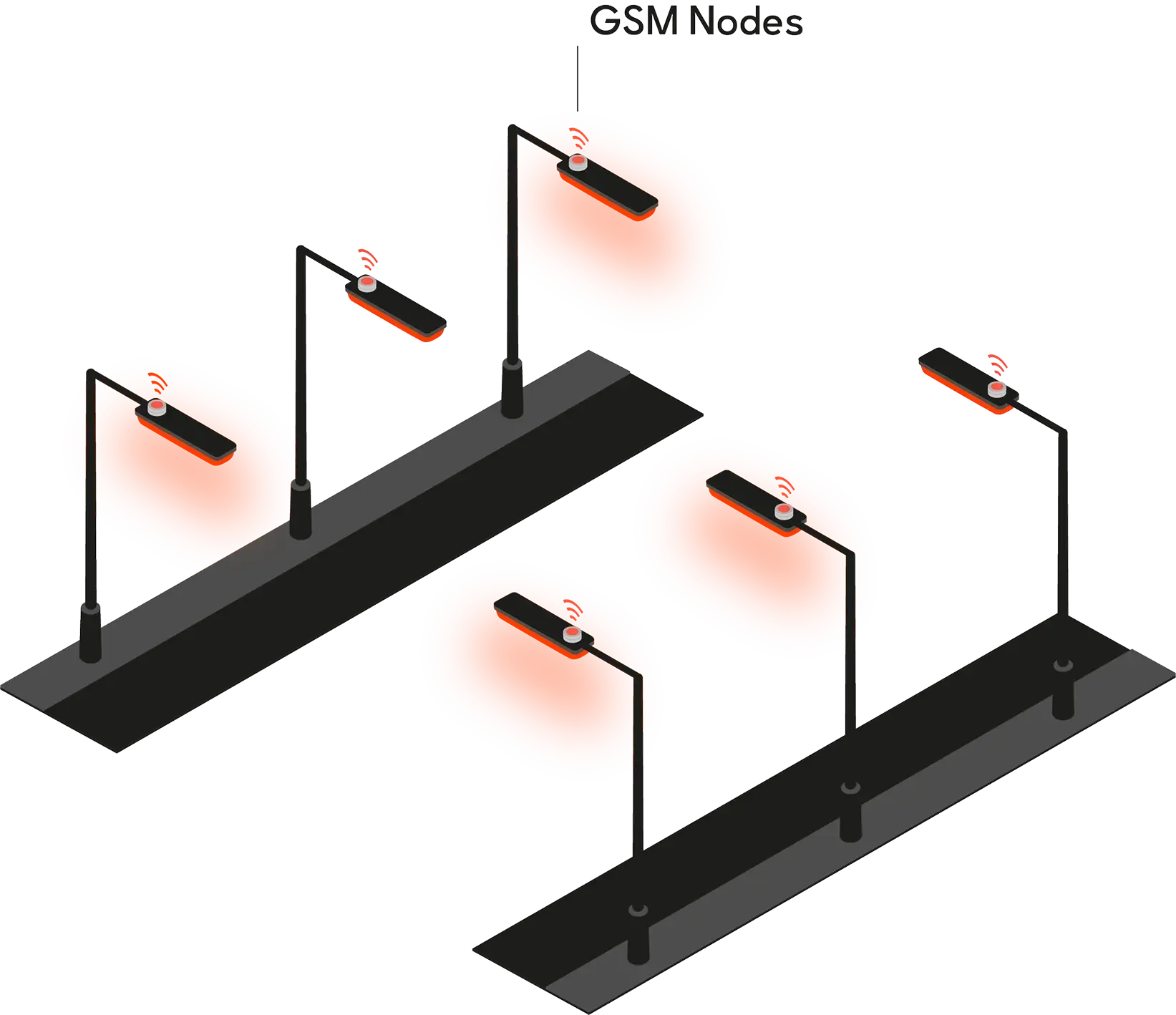
In GSM-based systems, each luminaire has a GSM/LTE IoT module and a dedicated SIM card, allowing direct communication with the central platform without the need for a base station.
How GSM Control Works
- Each luminaire connects directly to the software platform through the cellular network.
- Supports ON/OFF switching, dimming, diagnostics, and telemetry via the GSM/LTE backbone.
- Ideal for distributed or dense urban environments.
Technical Characteristics
- Independent communication channel for each luminaire.
- Works in areas with complex or obstructed RF propagation paths.
- No range limitations beyond the coverage of the mobile operator.
- Suitable for large-scale or multi-cabinet deployments.
Recommended Use Cases
GSM control is typically preferred when:
- luminaires are powered from decentralized electrical sources,
- the installation area has high building density,
- typical scenarios include central city districts, downtown zones, industrial campuses, or mixed-use urban areas.
DITRA's GSM/cellular street lighting solution is designed for exactly these scenarios.
GSM / Cellular vs RF Luminaire controllers — Which to choose. Technical comparison
| Parameter | RF Control (868/915 MHz) | GSM/LTE Control |
| Communication model | Node -> Base station | Node -> Cellular network |
| Infrastructure | Requires base station | No base station required |
| Latency | Low | Medium |
| Urban penetration | Good, but affected by high-rises | Strong in dense urban zones |
| Coverage | Limited by RF propagation | Coverage of mobile operator |
| Best for | Highways, suburban areas | City centres, tall buildings |
| Deployment cost | Lower | Higher (SIM per node) |
Advantages of Individual Wireless Control
- Per-luminaire visibility and real-time diagnostics.
- Independent dimming profiles.
- Adaptive lighting support (motion, daylight sensors).
- Scalable network topology.
- Works with NEMA, Zhaga, and wire nodes.
- Flexible deployment without cabinet infrastructure dependencies.
- Enables mixed and hybrid architectures.
Limitations
- Requires stable radio or cellular coverage.
- GSM-based systems incur SIM/service costs.
- RF performance may degrade in very dense urban areas.
- Higher node count → more distributed maintenance.
- Not ideal for long feeder lines with centralized supply (PLC/segment may be simpler).
When to Choose Individual Wireless Control
Choose wireless individual control when:
- precise per-luminaire management is required,
- luminaires are installed in decentralized locations,
- environmental conditions limit RF propagation (use GSM),
- RF conditions are favorable (use 868/915 MHz),
- segment or PLC control is not feasible,
- there is a need for maximum flexibility and intelligent sensor integration.