

Solar-Powered Street Lighting Control — Technical Overview
Solar-powered street lighting systems operate independently of the electrical grid by integrating photovoltaic (PV) panels, battery storage, and smart lighting controllers into each luminaire.
Control systems ensure that the luminaire operates predictably, efficiently, and safely under varying environmental and solar conditions.
A solar-powered lighting controller manages:
- PV energy harvesting,
- battery charging and protection,
- driver power delivery,
- dimming schedules,
- sensor-based adaptive lighting,
- diagnostics and remote monitoring.
Solar-powered street lighting is widely used in:
- rural regions without electrical infrastructure,
- remote roads and intercity routes,
- developing urban areas,
- locations where trenching for power cables is impractical or costly.
System Components
A typical solar-powered street lighting system includes:
Photovoltaic Panel
Converts solar energy to electrical DC power. Key parameters:
- rated power (Wp),
- efficiency,
- tilt angle and orientation,
- performance ratio (per IEC 61724).
Battery Storage
Common battery chemistries:
- LiFePO₄ (LFP) — long life, stable under high temperatures,
- NMC Li-ion,
- GEL/AGM lead-acid for low-cost installations.
Key metrics:
- depth of discharge (DoD),
- state of charge (SoC),
- cycle life,
- temperature tolerance.
Solar Charge Controller
Central power-management module. Core functions:
- MPPT (Maximum Power Point Tracking) for efficient PV harvesting,
- multi-stage battery charging (bulk / absorption / float),
- overcurrent, overvoltage, and thermal protection,
- load control for LED driver output.
LED Driver
Converts battery output into regulated current for the luminaire. Supports:
- fixed output,
- DALI / 0–10 V dimming (depending on architecture),
- hybrid solar-grid fallback (in semi-autonomous systems).
Smart Control Module
Responsible for:
- dimming schedules,
- sensor integration,
- telemetry (voltage, current, SoC),
- remote communication (GSM, LTE, RF).
Control Logic in Solar Street Lighting
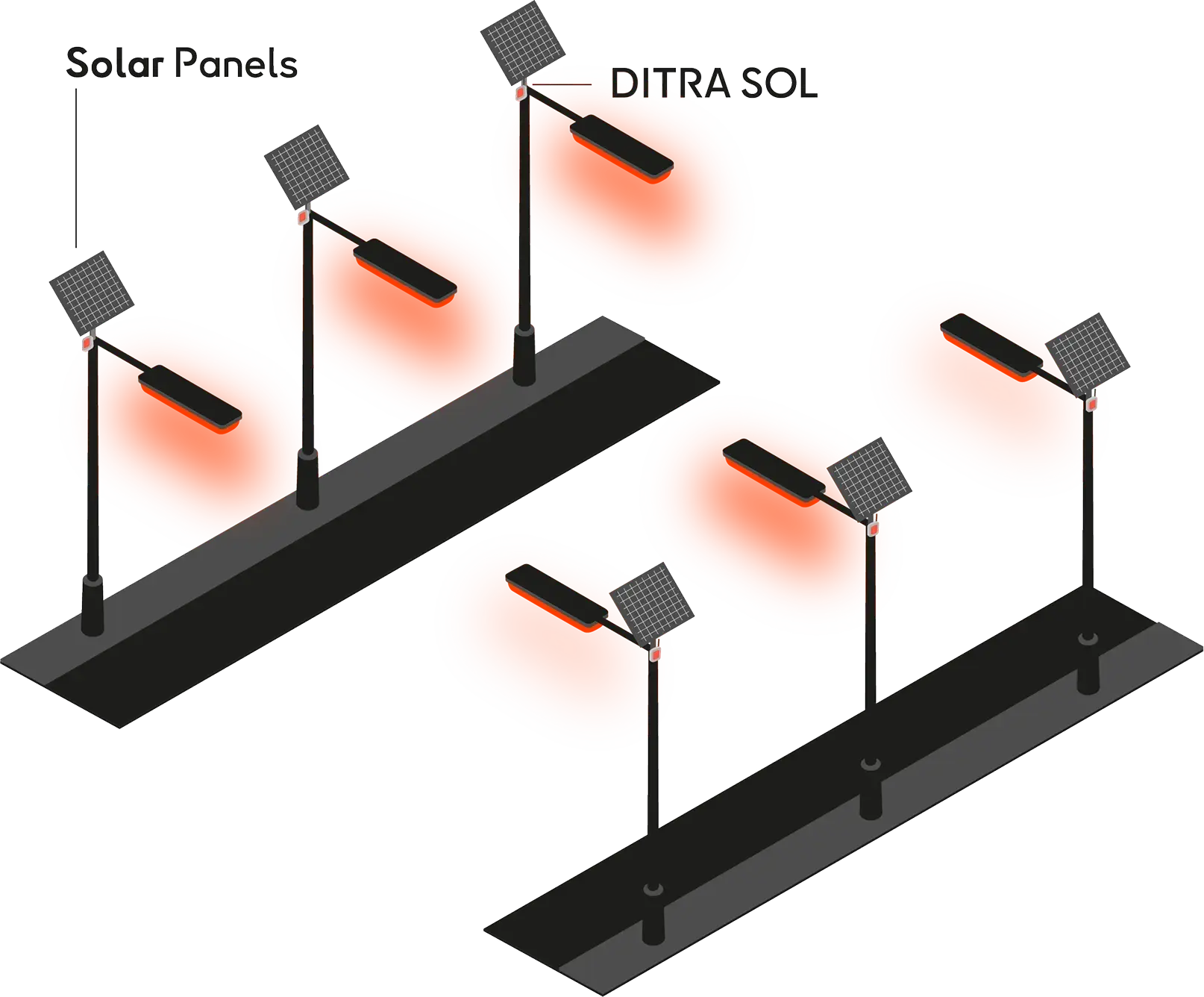
Solar street lighting controllers implement optimized logic to ensure stable operation regardless of weather or season.
Energy-Aware Dimming
The system automatically adjusts light output depending on:
- predicted energy availability,
- battery SoC,
- night length,
- seasonal irradiance patterns.
Battery Protection
Crucial for battery longevity:
- over-discharge protection,
- temperature compensation,
- overcharge limitation,
- low-voltage cutoff.
This follows best practices from IEC and IEEE photovoltaic storage guidelines.
Automatic Dusk/Dawn Detection
Based on:
- PV panel voltage drop,
- dedicated ambient light sensors,
- astronomical clock (optional).
Adaptive Lighting (PIR / Radar Sensors)
Motion sensors enable:
- dimming-on-demand,
- energy saving during no-traffic periods,
- safety enhancement when movement is detected.
Seasonal and Weather Compensation
Algorithms adjust:
- brightness levels,
- output duration,
- battery reserve threshold,
- storm/winter-mode restrictions.
Communication and Remote Monitoring
Solar-powered systems may be:
1. Standalone (No Communication)
Most basic configuration:
- local control only,
- fixed dimming profiles,
- no remote updates or diagnostics.
2. GSM/LTE-Connected
Advanced autonomous systems use IoT modems to provide:
- SoC monitoring,
- PV and load telemetry,
- fault alerts,
- remote configuration updates,
- anti-theft monitoring.
This is especially useful in municipal deployments where maintenance teams manage many dispersed solar installations.
3. RF Mesh Communication
Used where cellular connectivity is limited. Low-power RF networks can relay:
- SoC data,
- sensor data,
- control commands.
Advantages of Solar-Powered Street Lighting
- No grid dependency — suitable for regions without electrical infrastructure.
- Flexible deployment — no trenching or cabling required.
- Low operational costs — energy self-sufficient.
- Resilience — works during power outages.
- Environmentally sustainable — zero grid energy consumption.
- Fast installation — ideal for emergency or temporary lighting.
Limitations and Engineering Constraints
1. Climate Dependency
Reduced performance in:
- high-latitude regions,
- winter seasons,
- prolonged cloudy periods.
2. Battery Temperature Sensitivity
Battery performance decreases below 0°C and above 45°C.
3. Physical Space Constraints
Poles must support the panel area and weight.
4. Maintenance Requirements
Batteries must be inspected or replaced based on cycle life and environmental conditions.
These constraints are well-documented in IEA and World Bank solar lighting studies.
When to Use Solar-Powered Lighting
Solar-powered systems are optimal when:
- grid access is unavailable or costly,
- road lengths are small or dispersed,
- environmental protection prohibits trenching,
- quick deployment is required (post-disaster, temporary sites),
- energy independence is a priority.
Cities also use solar systems for:
- parks,
- bike paths,
- peri-urban roads,
- remote industrial sites.
Relation to Grid-Connected Lighting
Solar systems differ from grid-connected systems:
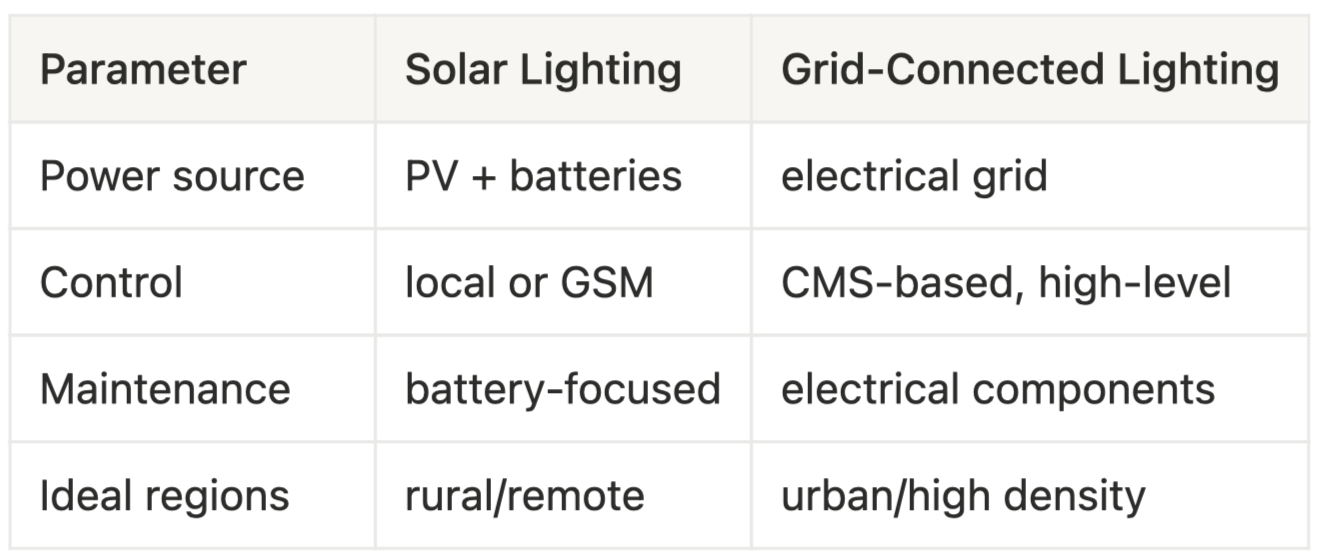
Hybrid systems (solar + grid fallback) exist to merge benefits of both.