Smart City Lighting Solutions: Architecture, Sensors, and Real-World Deployment Challenges
Lighting control, street sensors and city platform

Last updated: 21 May 2026 / 8 min read
Author: Valdo Baldwin
Most cities planning a smart city project assume they need to build a new digital network from scratch — dedicated fiber, new communication infrastructure, new poles. In most cases, that assumption is wrong.
Street lighting is already a distributed network that covers the entire city. Every pole has a power supply and standardized mounting points. That means it can host sensors, communication modules, and controllers today — without heavy civil works or full reconstruction.
According to the European Commission's Smart Lighting Factsheet (2021), street lighting has one of the highest potentials to become a true connectivity platform for urban services. This article explains how to use that potential in three concrete steps.
Why this matters financially: Energy, maintenance and the business case
- Cities often spend 20%+ of their energy budget on lighting.
- Around 75% of luminaires in use are over 25 years old and based on outdated technologies.
- Upgrading to LED luminaires plus intelligent control can reduce energy consumption by 50-70% and, at the same time, prepare the lighting network to act as the foundation for broader smart city services.

Three myths that block most Smart City Lighting Projects
The same objections come up in almost every municipal team before a project starts. Here is what the evidence actually shows.
Myth 1. "We have to replace all the infrastructure."
Reality:
Most projects start with 5-10% of the lighting network - a few key streets, a district, or a waterfront area. If the architecture is open and scalable, this pilot can later grow to the whole city.
Myth 2. "Smart city projects are only for very large capitals."
Reality:
Medium and even small cities can benefit from connected lighting and sensors: safer crossings, better energy control, fewer emergency call-outs. The overall budget can remain modest, while the impact for residents is clearly visible.
Myth 3. "It's too complex and expensive."
Reality:
When implemented step by step, these projects often pay for themselves through:
- reduced energy consumption thanks to dimming and precise scheduling;
- fewer emergency call-outs and on-site interventions;
- better reporting on sustainability goals (ESG, CO2, and overall environmental quality).
With the right architecture, you can capture these "quick wins" first and then gradually add new services without having to redo what has already been built.
Step 1 — Smart City Lighting Control Architecture: The first decision that defines everything
Before adding sensors or software, the lighting network has to become something you can reliably control. The first practical decision is simple but crucial: what control architecture will you use, and where will you start? This choice defines how easily the project can grow from a pilot to a full smart city system.
Three quick-start scenarios for your first pilot area
Pilot on 1–2 streets. Pick a visible area — a main street, a square, or a waterfront. Add cabinet or segment controllers and apply a few dimming profiles. This is enough to show immediate energy savings and measurably better comfort, and to build the case for expanding further.
LED program with built-in control. Each time you replace a luminaire with an LED, add a control node — NEMA, Zhaga, wired, or integrated. This way, your existing LED upgrade program automatically builds a connected network over time, with no separate rollout required.
Mixed fleet, mixed control. Use individual luminaire control where you already have LED or plan to replace luminaires soon. Keep legacy areas under cabinet or segment control until they are upgraded. This hybrid approach avoids forcing a single solution across a network that is not uniform.
The most common mistake in Smart City projects — Choosing a closed system
Choosing a system that only works with one vendor and cannot accept third-party sensors, nodes, or platforms is the single most common mistake cities make at this stage. An open, interoperable architecture keeps your options open and lets you add new services later without redoing the first project.
Step 2 — Smart City sensors for street infrastructure: Start with human needs, not technology
Once your lighting network is under control, you do not need all sensor types at once. There are dozens of options on the market, but three categories most directly improve residents' comfort and safety — and these make the most practical starting point.
Safety & Comfort — Motion, daylight and noise sensors
The goal here is to make streets feel safer and more comfortable for people — not just to improve an energy report. Start with a few critical crossings, routes with existing safety complaints, and quiet areas that feel empty or isolated after dark.
Sensors for this category: motion, daylight, noise, basic meteorological sensors.
For a detailed technical overview of each sensor type, see our Smart Street Lighting Sensors guide.
Emergency detection — Fire, flood and seismic sensors
The focus here is on early detection of dangerous events and timely response, before people or infrastructure are seriously affected. Sensors can detect smoke and fire, rising water levels, or unusual ground motion around critical assets.
Sensors for this category: smoke and fire detectors, flood and water-level sensors, seismic and vibration sensors.
Environment & Quality of life — Air quality, temperature and microclimate
Smart city projects are increasingly evaluated through sustainability and liveability indicators. By measuring air quality, noise, heat, and microclimate, cities can improve everyday comfort, support their reputation as attractive places to live, and back investment decisions with objective data.
Sensors for this category: air quality, temperature and humidity, noise, basic environmental probes.

Step 3 — Smart City Lighting Control Software: From scattered devices to one city platform
Once lighting, controllers, and sensors are in place, the next step is to bring everything together in one platform — a practical operating system for the city. This is where individual components become a coherent, manageable system.
What a city operating platform gives you
A smart city platform connects all control nodes and sensors into a single view:
- Real-time telemetry — status of all controllers, nodes, and sensors at any moment.
- Advanced reporting — energy use, alarms, SLAs, and maintenance KPIs in one place.
- City map in one window — cabinets, poles, segments, and events shown directly on the map.
Instead of working across multiple disconnected tools, the operations team has one environment for operations, analytics, and planning. See in our article how to choose the right street lighting management platform for your city.
Open APIs and modular integration — How to connect CCTV, SCADA and City Portals
A future-proof platform is not a closed box. It must connect to the rest of the city's systems. External services — CCTV, SCADA, traffic management, city portals — can be added as modules. Data can also be shared outward via open APIs to other city platforms, digital twins, or reporting tools.
This modular approach means new services can be added over time without redesigning the core system every time a new requirement appears.
Smart City lighting roadmap — From pilot to full deployment in 12 months
You do not need to do everything at once. Even starting from a purely conventional lighting network, a realistic one-year path looks like this:
| Quarter | Phase | Key actions | Outcome |
| Q1 | Audit & Design | Map existing street lighting network. Define pilot area — district, corridor, or waterfront. Choose LED and control architecture. | Clear scope, architecture decision, pilot boundaries defined |
| Q2 | Install & Connect | Roll out LED luminaires and cabinet or luminaire controllers. Connect to central software with basic dashboards and alarms. | First area under control, energy savings visible |
| Q3 | Sensors & Integrations | Deploy safety, mobility, or environment sensors on existing poles. Connect at least one external system — reporting tool or city portal. | Live sensor data in platform, first integration running |
| Q4 | Scale & Review | Extend control and sensors to new areas. Compare energy and maintenance costs before and after. Plan next phase. | Full pilot results, roadmap for city-wide rollout |

DITRA Solutions for Smart City Lighting Projects
Building a smart city on existing street infrastructure requires hardware, sensors, and software that work together as one system — and stay open to future expansion. DITRA Solutions provides all three layers.
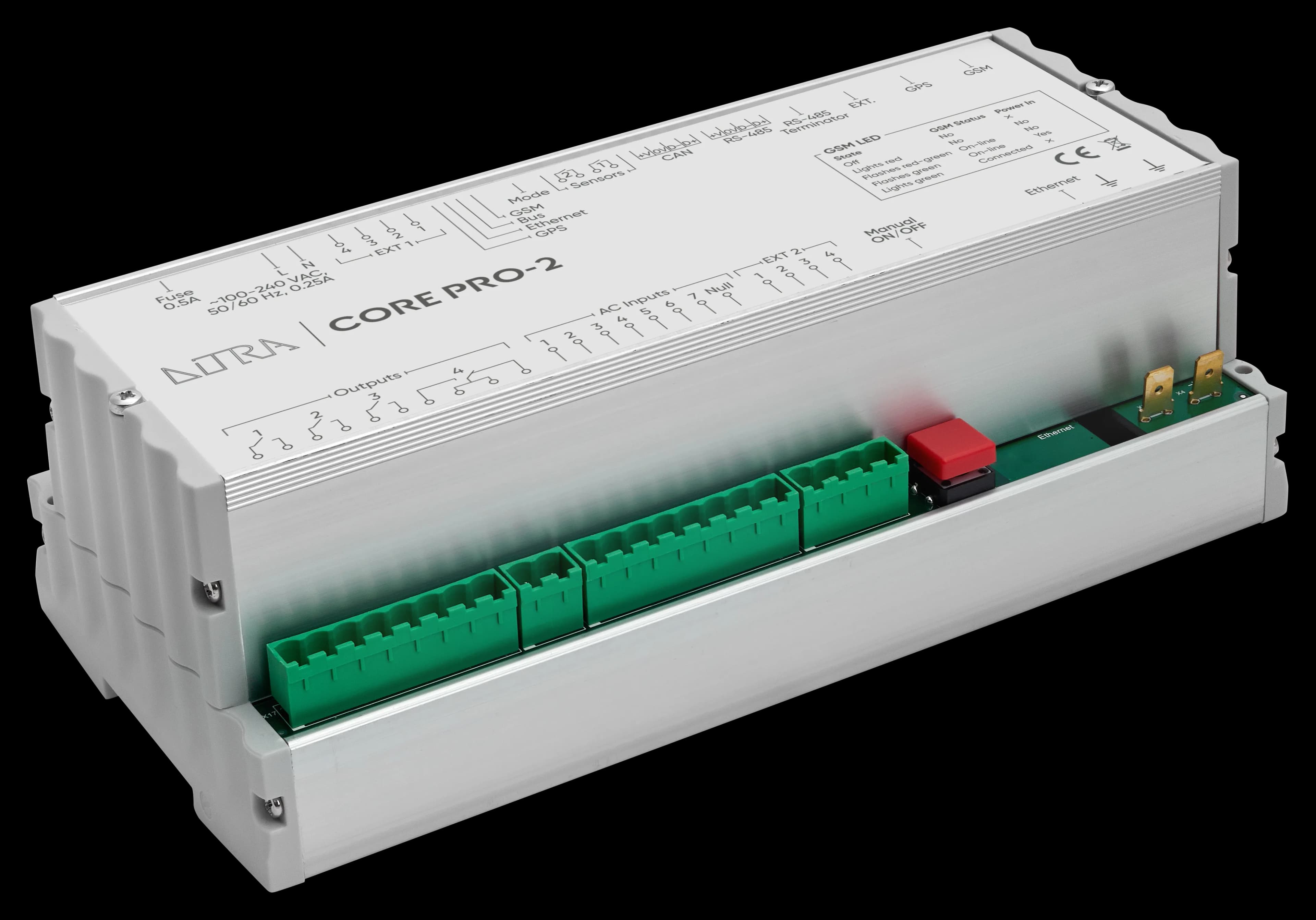
At the control level, the portfolio includes cabinet and segment controllers, pole-mounted nodes with NEMA and Zhaga interfaces, and PLC, RF, and GSM communication options. This allows cities to reuse existing cabinets and feeders, combine cabinet-level and individual luminaire control within one system, and keep the architecture open so third-party sensors and future devices can be added at any stage.
At the sensor level, DITRA controllers support standard industrial protocols including Modbus and CAN. This means cities are not locked into a single sensor vendor — both DITRA's own sensor range and third-party devices connect within the same infrastructure.
At the platform level, DITRA Synergy works as an integration layer. It collects data from field IoT devices and controllers, and connects external systems — surveillance cameras, SCADA, existing smart city platforms — via open APIs. Depending on the project, it can serve as the main central platform or feed data into another citywide system.
All components are designed to scale: the first pilot area can grow into a full-city deployment without rebuilding what has already been installed.