PLC vs DALI in tunnel lighting: Which control architecture is more cost-effective?
Engineering comparison for a 1 km tunnel with 1,504 luminaires
Last updated: 30 June 2026 / 8 min read
Author: Valdo Baldwin
Choosing the right tunnel lighting control system has a major impact on project cost, system complexity, maintenance, and long-term operation. While PLC and DALI both support adaptive dimming, zonal control, and fast response required by CIE 88:2004, they differ significantly in hardware architecture, equipment quantity, and typical application scenarios.
This article compares Wire PLC and DALI-2 for tunnel lighting using an engineering calculation for a 1 km twin-bore road tunnel with four traffic lanes and 1,504 luminaires.
In this article, you'll learn:
- How PLC and DALI differ in tunnel lighting applications.
- How each architecture affects CAPEX, installation, and maintenance.
- When PLC is the better choice and when DALI provides a more cost-effective solution.
- How both systems meet the requirements of CIE 88:2004.
- How many controllers and field devices are required for a 1 km tunnel with 1,504 luminaires.
For a fair comparison, both systems are evaluated under the same conditions. Both operate in broadcast mode, allowing dimming commands to be transmitted simultaneously to all luminaires within the corresponding lighting zone. This is a fundamental requirement for tunnel lighting, where brightness levels must adapt within seconds.
The comparison is based on engineering calculations rather than product preference.
Why tunnel lighting is different from Street Lighting
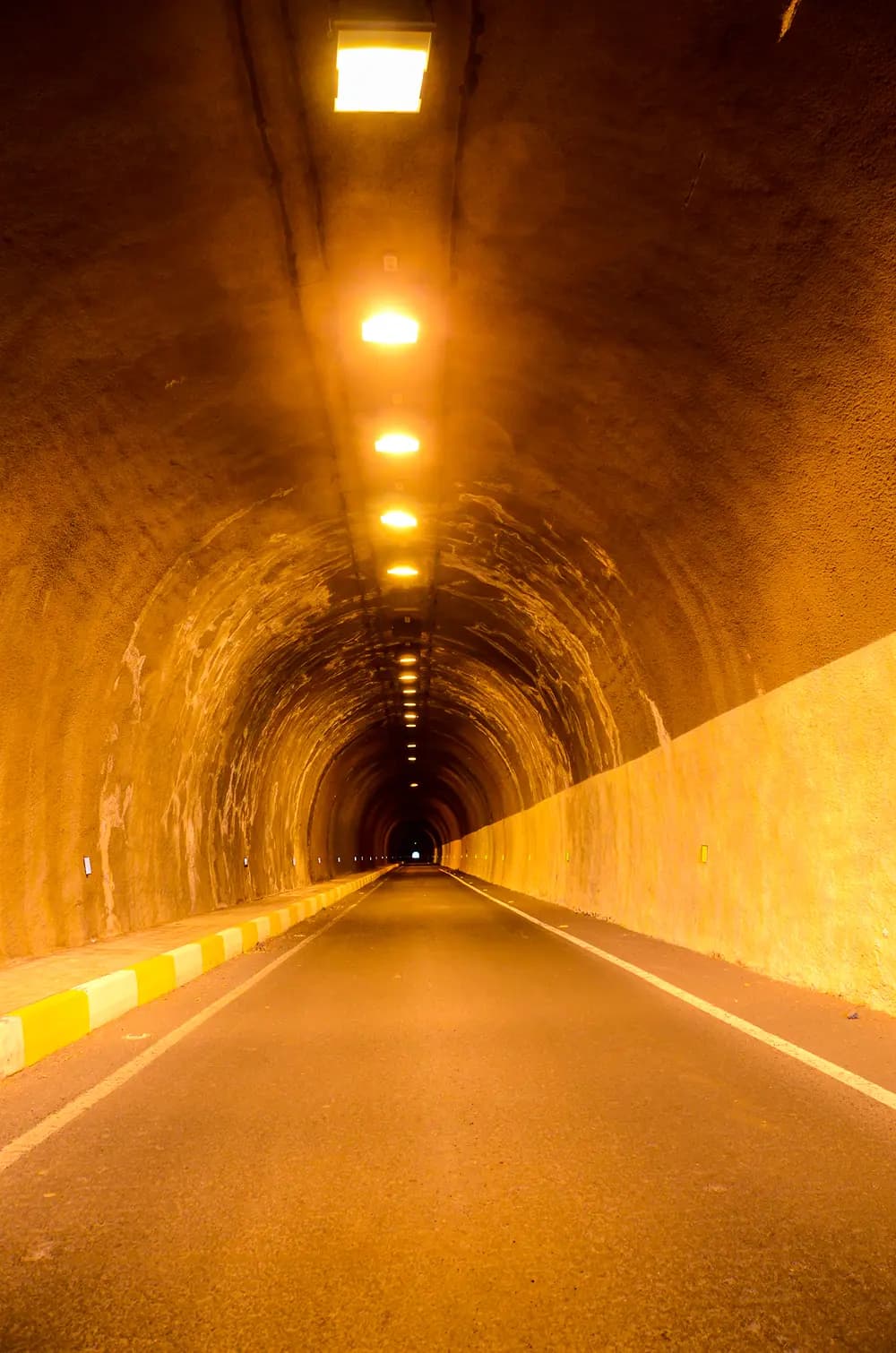
Street lighting typically consists of luminaires mounted on poles spaced 30–40 metres apart along the road. Tunnel lighting is fundamentally different for several reasons.
1. Extremely high luminaire density
According to CIE 88:2004, the luminance level in the tunnel threshold zone is not a fixed value. It is calculated based on the external luminance before the tunnel entrance, referred to as the L20 parameter, which depends on the brightness of the portal, surrounding surfaces, portal orientation, road surface characteristics, and environmental conditions. As a result, the threshold zone generally requires the highest lighting level, but the exact value is determined individually for each project.
The luminance difference between the threshold zone and the middle of the tunnel is significant. Managing this transition smoothly and safely is one of the primary functions of the control system.
2. Continuous 24/7 operation
A tunnel never stops operating. Any technical compromise made during the design stage will affect daily operation for many years.
3. Road safety requirements
The luminance of the threshold zone must change dynamically as the external luminance at the tunnel portal changes. Once the tunnel luminance sensor detects a change, the control system must calculate and apply a new dimming level within seconds, not minutes. Delayed response represents non-compliance with the standard and increases the risk of traffic accidents.
4. Harsh operating environment
Vibration, humidity, exhaust gases, and temperature fluctuations near tunnel portals place increased demands on the reliability of every system component. The more components the system contains, the greater the probability of failure.
What the tunnel lighting control system must do
Before comparing architectures, it is important to define the requirements. CIE 88:2004 approaches tunnel lighting from the perspective of traffic safety rather than energy savings. This translates into four essential functions.
- Fast response to changing luminance at the portal. External luminance sensor → threshold zone dimming command → response within seconds.
- Independent zonal dimming control. Threshold (Th), transition (Tr), interior (In), and exit (Ex) zones are controlled independently and simultaneously with different luminance levels.
- Safety scenarios. Accidents, power failures, and maintenance operations must activate predefined lighting scenarios immediately.
- Fault monitoring. The system must accurately identify failed luminaires to enable targeted maintenance instead of manual inspection of the entire tunnel.
These four requirements form the basis for evaluating both architectures.
How a PLC system works in tunnel lighting
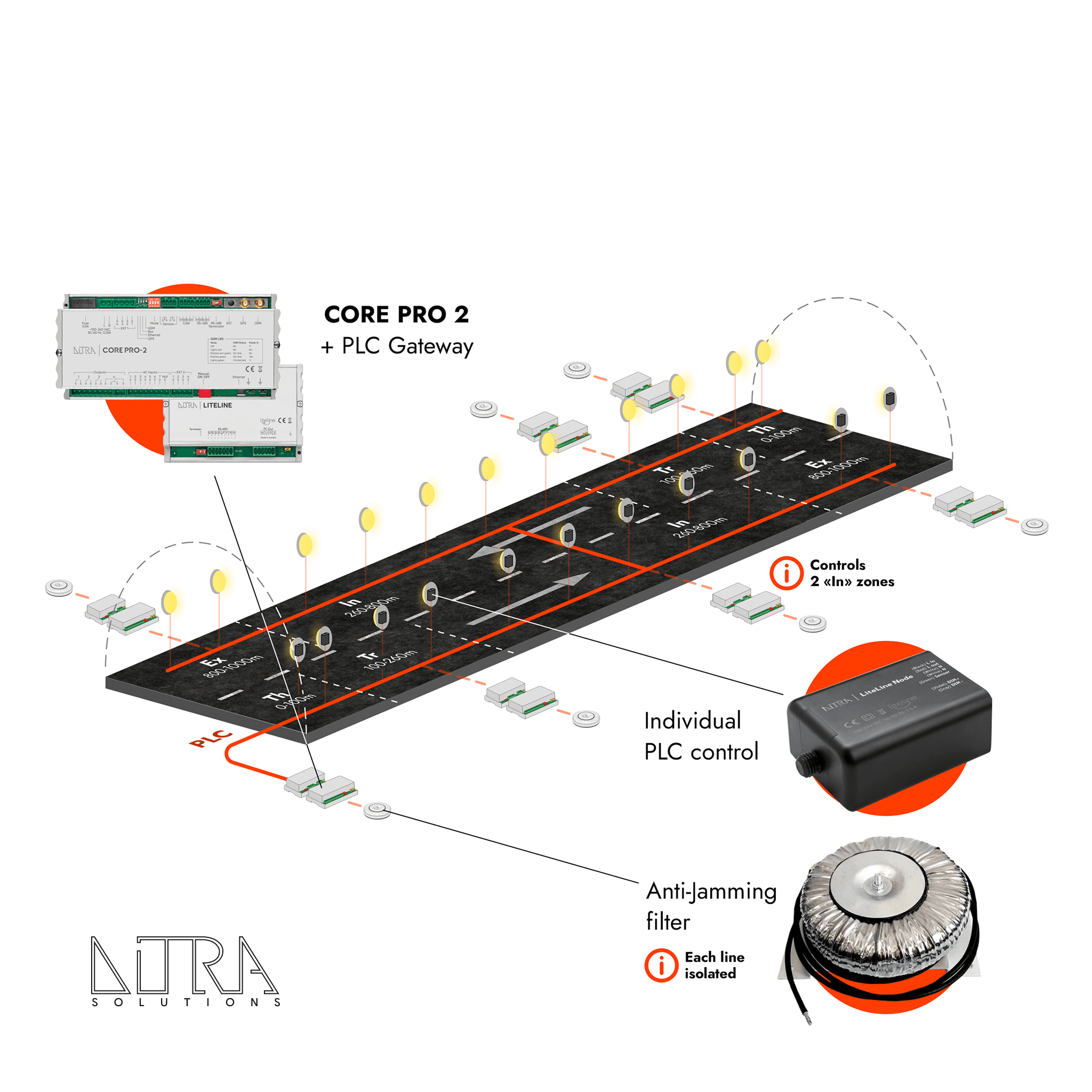
Wire PLC (Power Line Communication) is a technology that transmits control commands and telemetry over existing power cables. No separate control cable is required.
The PLC architecture for a tunnel consists of three levels.
- Central Controller – responsible for communication with the upper-level server, control of lighting power circuits, and interaction with third-party equipment via RS-485/Modbus. It provides monitoring, control, and integration with tunnel engineering systems.
- PLC Gateway – converts controller commands into PLC signals transmitted over the power line. Each gateway serves one network segment.
- Wire PLC Node – installed inside each luminaire. It receives commands from the gateway, measures electrical consumption parameters, and reports status information.
PLC advantages and disadvantages in tunnel lighting
Advantages
- Individual energy monitoring. Each Wire PLC Node measures power consumption, current, and voltage directly at the luminaire. Detailed energy monitoring is available without requiring DALI D4i drivers.
- No separate control cable required. Communication uses existing power cables, reducing material and installation costs in retrofit projects or installations with complex topology.
Disadvantages
- Higher cost in high-density installations. Each luminaire requires its own PLC Node. This becomes a significant CAPEX item that grows proportionally with the number of luminaires.
- More components mean more potential failure points. In addition to PLC Nodes, the system requires gateways, filters, and matching components. In the harsh tunnel environment, every additional component represents another potential point of failure.
How a DALI system works in tunnel lighting
DALI (Digital Addressable Lighting Interface, IEC 62386) is an international standard for controlling lighting equipment via a dedicated two-wire communication bus. Each luminaire on the bus has a unique address, and communication is bidirectional: the controller sends commands and receives confirmation that they have been executed.
The fundamental difference from PLC is that the DALI protocol is implemented directly inside the luminaire driver. No separate control module is required for each luminaire.
DALI advantages and disadvantages in tunnel lighting
Advantages
- Lower control system cost in high-density installations. Seven DALIGATE units instead of 1,504 PLC Nodes, with no separate control modules required for each luminaire. The reduction in hardware quantity is significant.
- Less equipment means higher reliability. Fewer components in the harsh tunnel environment result in fewer potential failure points.
Disadvantages
- Requires a dedicated DALI cable. A separate two-wire control bus must be installed throughout the entire tunnel, adding an additional cable route to the project.
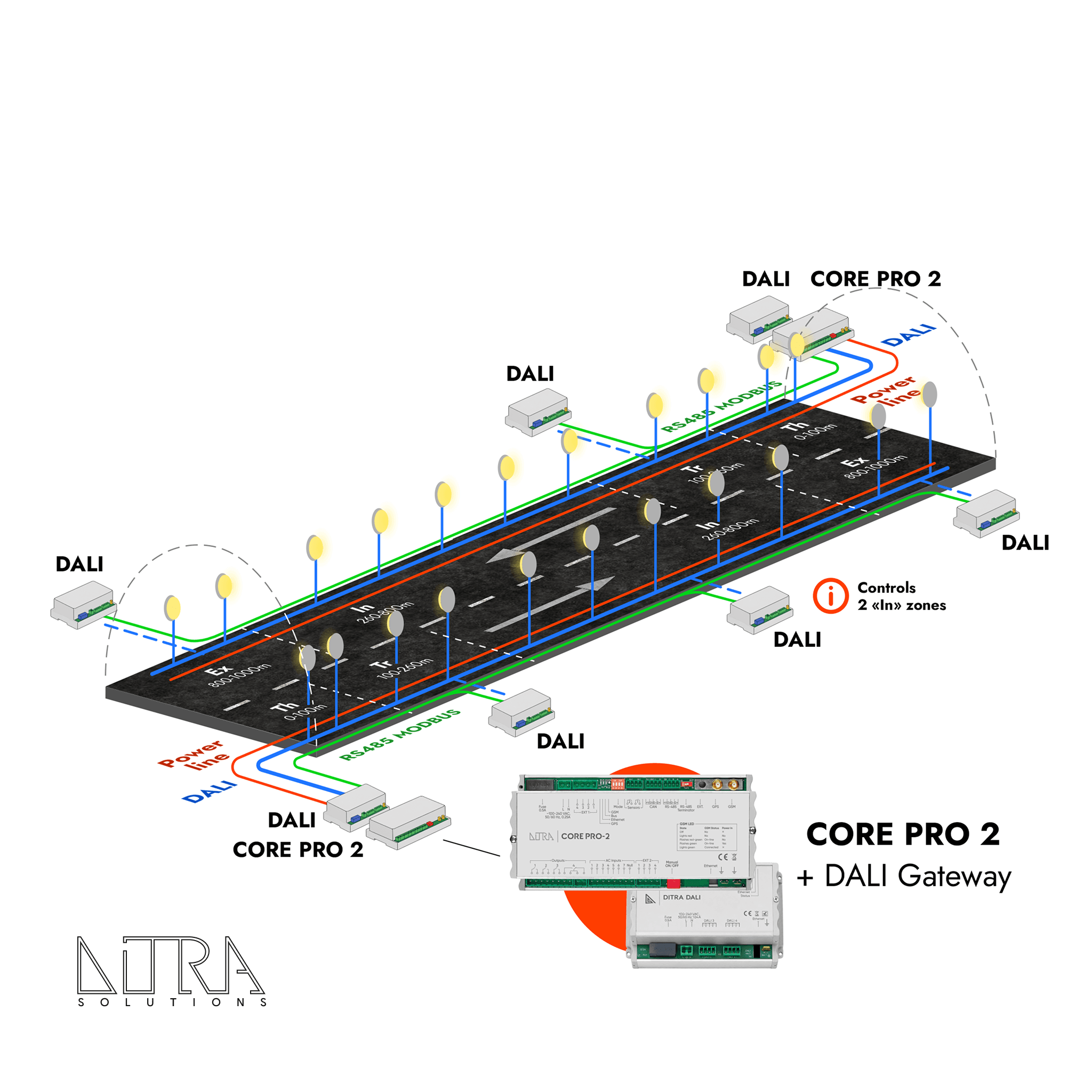
- Bus length limited to 300 metres per line. For tunnels longer than 300 metres, several DALIGATE units must be distributed along the tunnel (as shown in this calculation).
- Individual energy monitoring requires DALI D4i drivers. Standard DALI supports dimming and diagnostics. Accurate energy monitoring for each luminaire requires DALI D4i drivers, which are still relatively uncommon on the market and typically cost approximately 30% more than standard DALI drivers. If detailed energy monitoring is required by the project specification, this should be considered when selecting luminaires.
PLC and DALI comparison for a 1 km tunnel
Calculation assumptions: 1 km tunnel, two bores, opposite traffic directions, four lanes, 1,504 luminaires, CIE 88:2004.
| Parameter | Wire PLC | DALI-2 |
| Central controller | 7 × DITRA COREPRO-2 | 2 × DITRA COREPRO-2 |
| Gateways / concentrators | 7 PLC Gateways | 7 DALIGATE |
| Luminaire control nodes | 1,504 Wire PLC Nodes (one per luminaire) | Not required. DALI functionality is integrated into the driver. |
| Dedicated control cable | Not required (communication over the power line) | Required. DALI bus installed along the tunnel. |
| Dimming command response time | Instant (broadcast) | Instant (broadcast) |
| Fault detecion time | Up to 85 minutes (polling 510 nodes, 10 s/node) | Up to 85 minutes for full polling (510 devices, 10 s/device). |
| Individual energy monitoring | Yes. Each PLC Node measures energy consumption. | Available only with DALI D4i drivers. |
| Control system CAPEX | For retrofit projects and applications requiring individual energy monitoring of every luminaire, PLC can be the more economical solution. | For new tunnel projects with a high luminaire density, DALI typically requires fewer control system components. |
Architecture comparison: Wire PLC vs DALI-2
Calculation basis: 1 km tunnel · 2 bores (opposite traffic) · 4 lanes · 1,504 luminaires · CIE 88:2004 / EN 13201.
PLC: broadcast mode, telemetry every 10 seconds per node.
DALI: bus length up to 300 m, RS-485 up to 500 m (each DALI Gateway acts as a repeater, allowing gateways to be connected every 300 m to cover the entire tunnel, with a maximum of three repeaters).
When PLC is the better choice
PLC is not universally the wrong choice. There are specific applications where it provides clear advantages.
- Tender requirements for individual energy monitoring. If the project specification or concession agreement requires measurement of power consumption for every individual luminaire with detailed reporting, PLC Nodes provide this functionality without requiring DALI D4i drivers.
- Retrofit of existing tunnels. For new tunnels, control cables are usually installed together with power cables and have little impact on the overall budget. However, when modernising existing tunnels, the cost of installing new control cable routes can greatly exceed the cost of the cable itself. In such projects, PLC enables lighting control using the existing power infrastructure without installing additional communication lines. In these cases, a detailed cost analysis is required, and PLC may prove to be the more economical solution.
For new projects where individual energy monitoring is either not required or can be provided by DALI D4i luminaires, PLC becomes more expensive than DALI in high-density installations because of the requirement for 1,504 PLC Nodes.
Conclusion
- CIE 88:2004 regulates tunnel lighting from the perspective of traffic safety and driver adaptation rather than energy monitoring.
- The standard requires rapid response to changing conditions, zonal luminance control, and continuous monitoring of system status. Both PLC and DALI are capable of meeting these requirements.
- Both architectures are well suited to these tasks, but in most cases DALI is simply 5–7 times less expensive.
- For a 1 km tunnel with 1,504 luminaires: 7 DALIGATE units versus 1,504 PLC Nodes is not a minor technical difference. It represents a substantial difference in equipment cost, installation effort, and maintenance complexity.
- If the tender or technical specification requires individual energy measurement for every luminaire, PLC is a justified choice. In all other cases, for tunnels with standard zonal lighting requirements, DALI-2 provides a simpler and more economical solution.
How Ditra Solutions implements this in practice
Ditra Solutions develops and supplies tunnel lighting control equipment based on both DALI-2 and Wire PLC architectures. The unified DITRA COREPRO-2 control platform supports both protocols, allowing the control architecture to be selected according to project requirements rather than supplier limitations. Since Ditra supplies both technologies, we can deliver combined solutions within a single control platform.
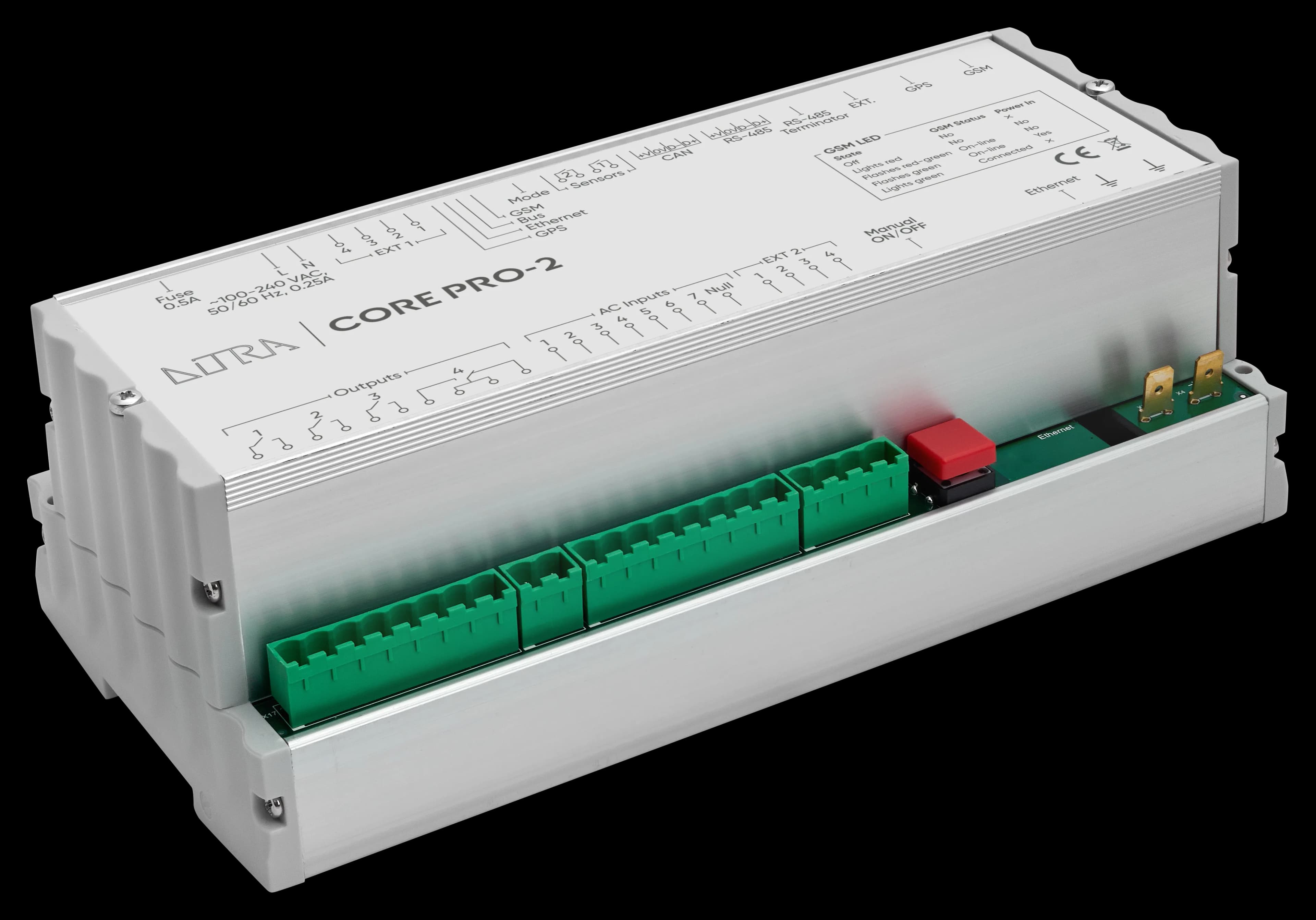
DITRA COREPRO-2 – Central controller. Receives luminance (not illuminance) sensor data, communicates with the server, controls lighting power circuits, and provides RS-485/Modbus connectivity to gateways and third-party controllers. Compatible with both DALIGATE and PLC Gateway.
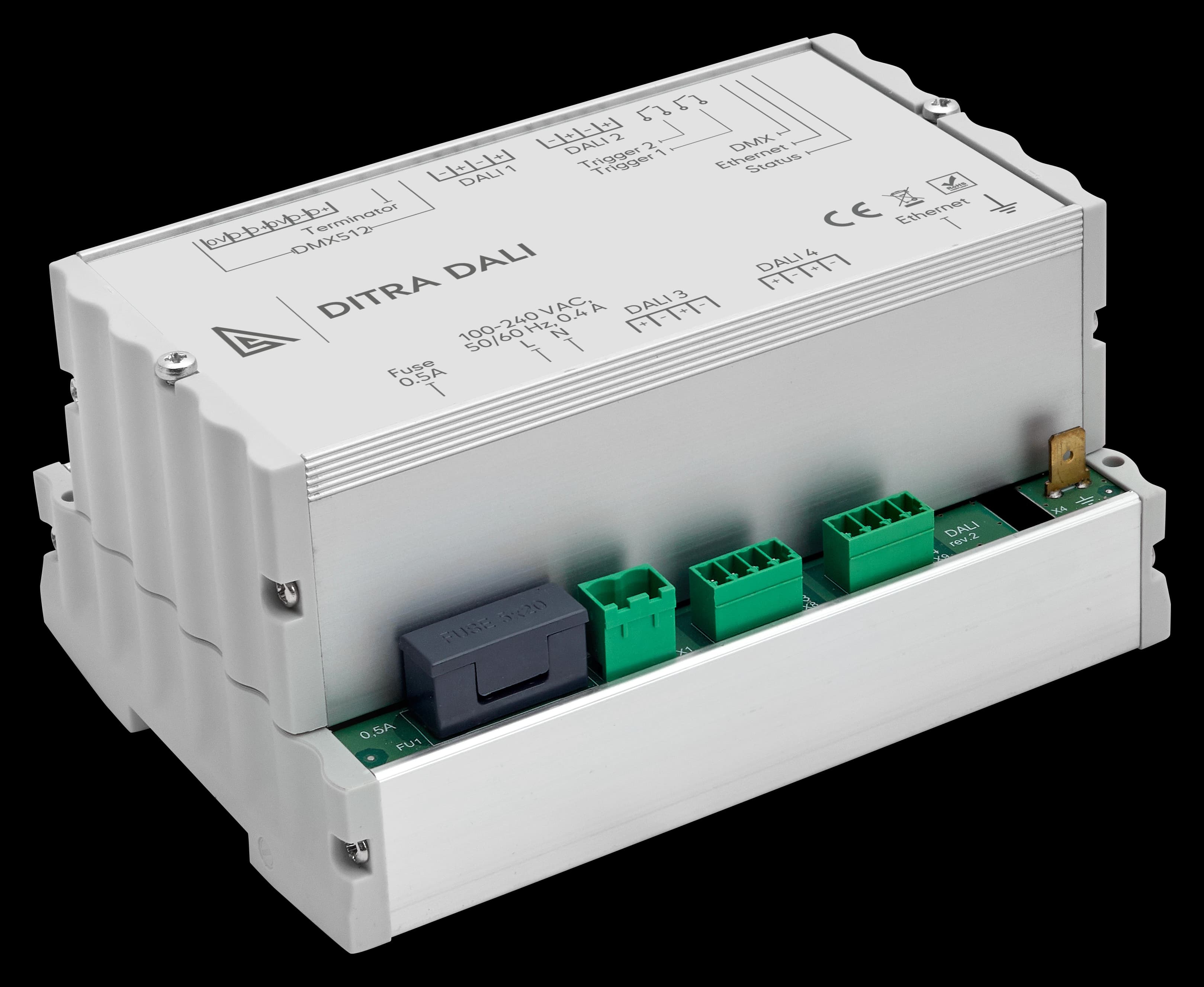
DITRA DALIGATE – DALI bus controller with four independent DALI-2 lines supporting up to 256 luminaires. Designed for projects requiring fast response, accurate diagnostics, and a minimum amount of control equipment.
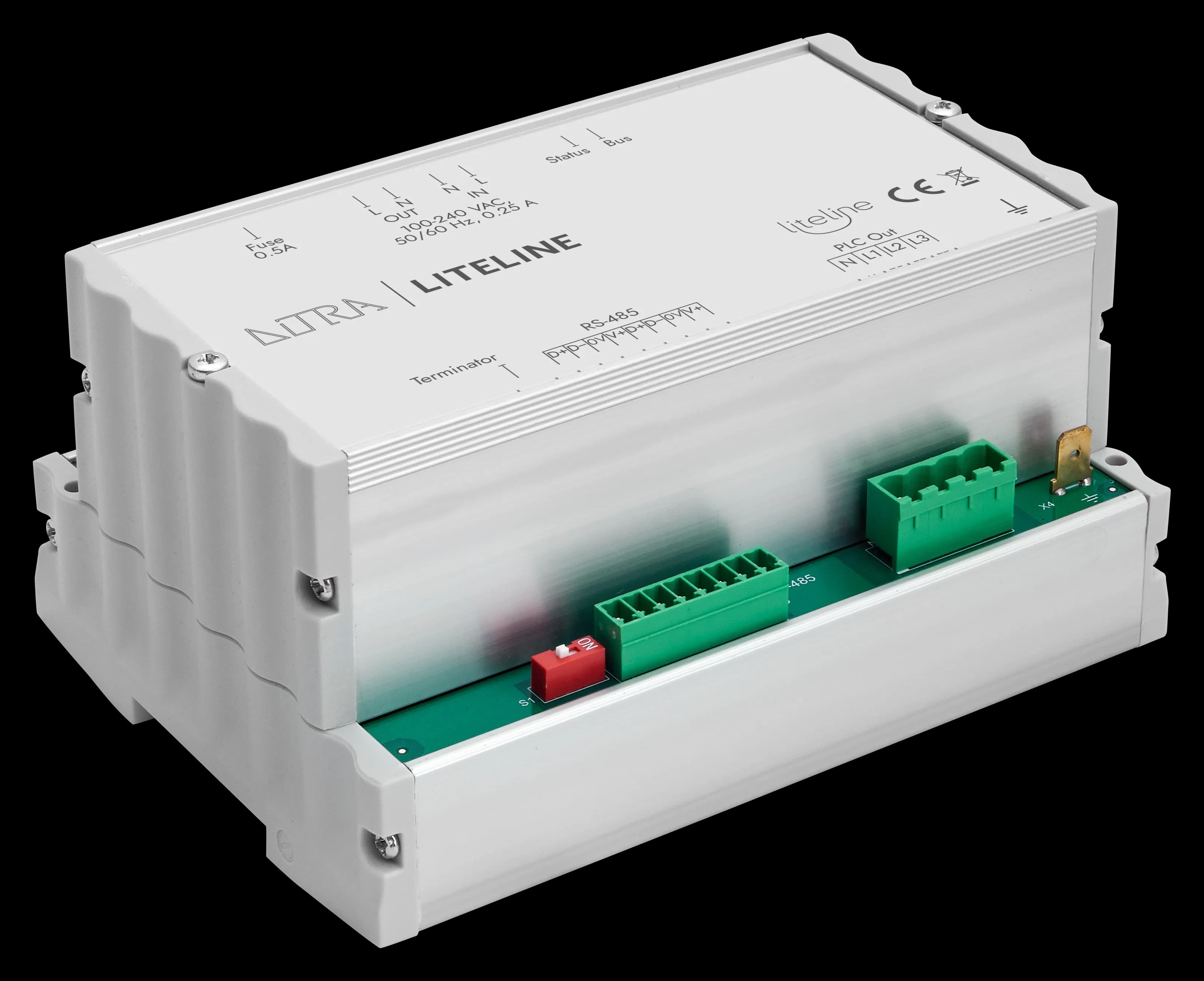
PLC Gateway + Wire PLC Node – intended for projects requiring individual energy monitoring or retrofit applications. Broadcast mode ensures simultaneous transmission of dimming commands to all luminaires.
Engineering calculations, technical specifications, and project documentation for specific projects are available upon request from Ditra Solutions.