Long-Distance RGB Lighting Control: Sync Architectures for Outdoor Installations
Choosing the right infrastructure for distributed lighting control

Last updated: 20 April 2026 / 2 min read
Synchronizing RGB lighting scenes across distances is one of the most technically demanding challenges in outdoor lighting design. Standard wireless DMX retransmission fails after 3–4 hops — causing frame drops, color drift, and broken animations.
This guide compares the two architectures that actually work at scale: fiber optic and GSM with GPS sync.
Why device-to-device retransmission may be insufficient
Some projects use systems where one controller receives the signal and then passes it to the next. This may work for simple actions (on/off, dimming), but becomes a technical bottleneck when managing dynamic RGB scenes, which require high synchronization and signal stability.
In a typical wireless DMX control architecture:
- The master station signal can cover up to 300–500 meters
- With retransmission (hopping), each additional hop adds only ~100 meters of reliable range
After 3–4 hops:
- Data transmission delays increase
- Packet loss and command distortion become more likely
- RGB scenes start to fall out of sync
- Animations degrade or fail to render
As a result, when managing long lighting lines with many nodes, cascading DMX signal retransmission becomes unreliable, especially for animations or advanced lighting effects.
Recommended architectures for long-distance RGB scene control
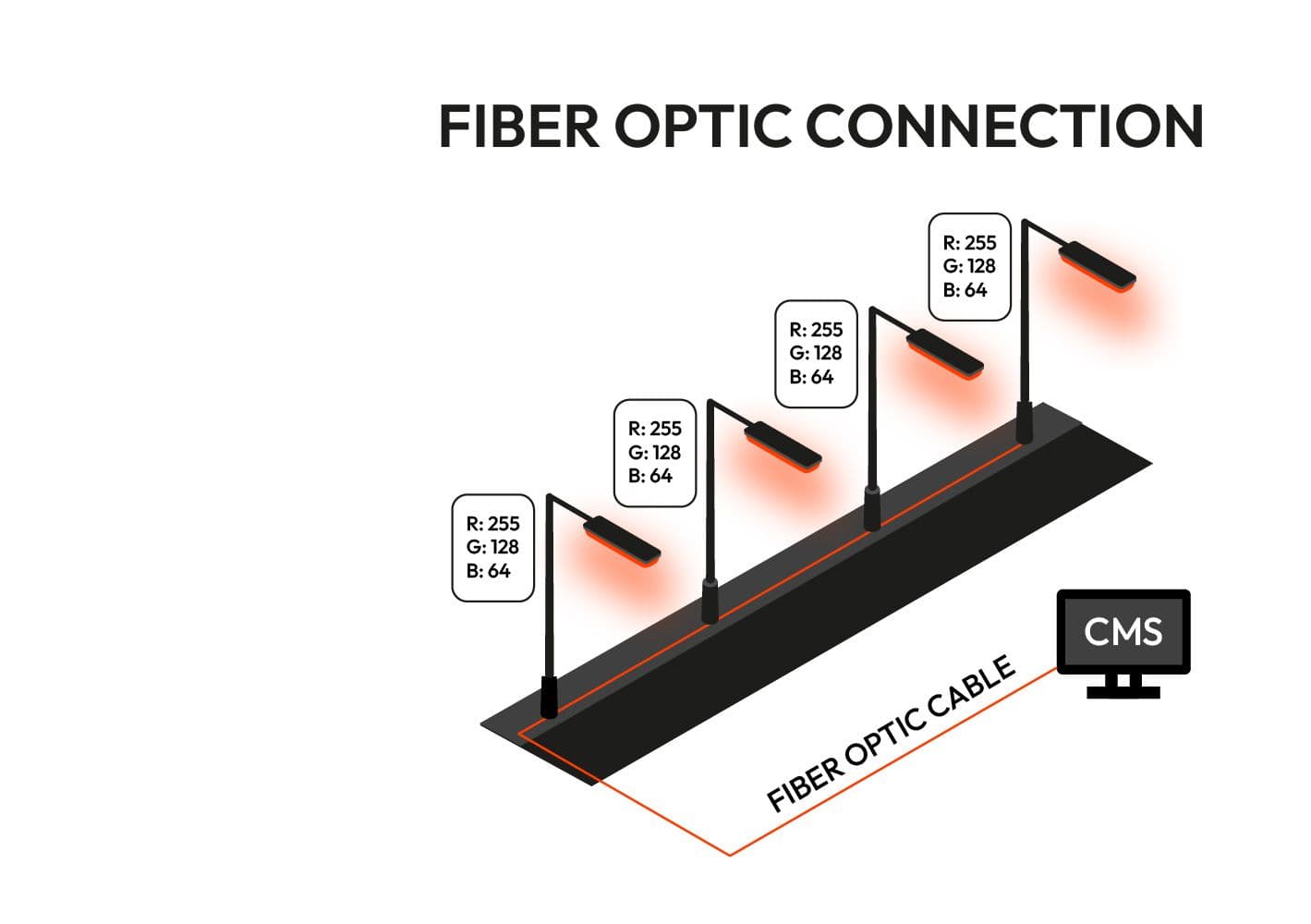
Fiber optic infrastructure for synchronized RGB scenes
If the project is at the construction stage, and there is a chance to install control lines along with the power infrastructure, fiber optics remains the most technically robust solution:
- Supports any protocol: DMX, Art-Net, sACN
- Fully synchronized, immune to radio interference
- Long-term reliability in continuous operation
While fiber offers the best performance, it's important to note that groundwork and materials significantly increase the budget, often making this solution less feasible for retrofits or existing installations.
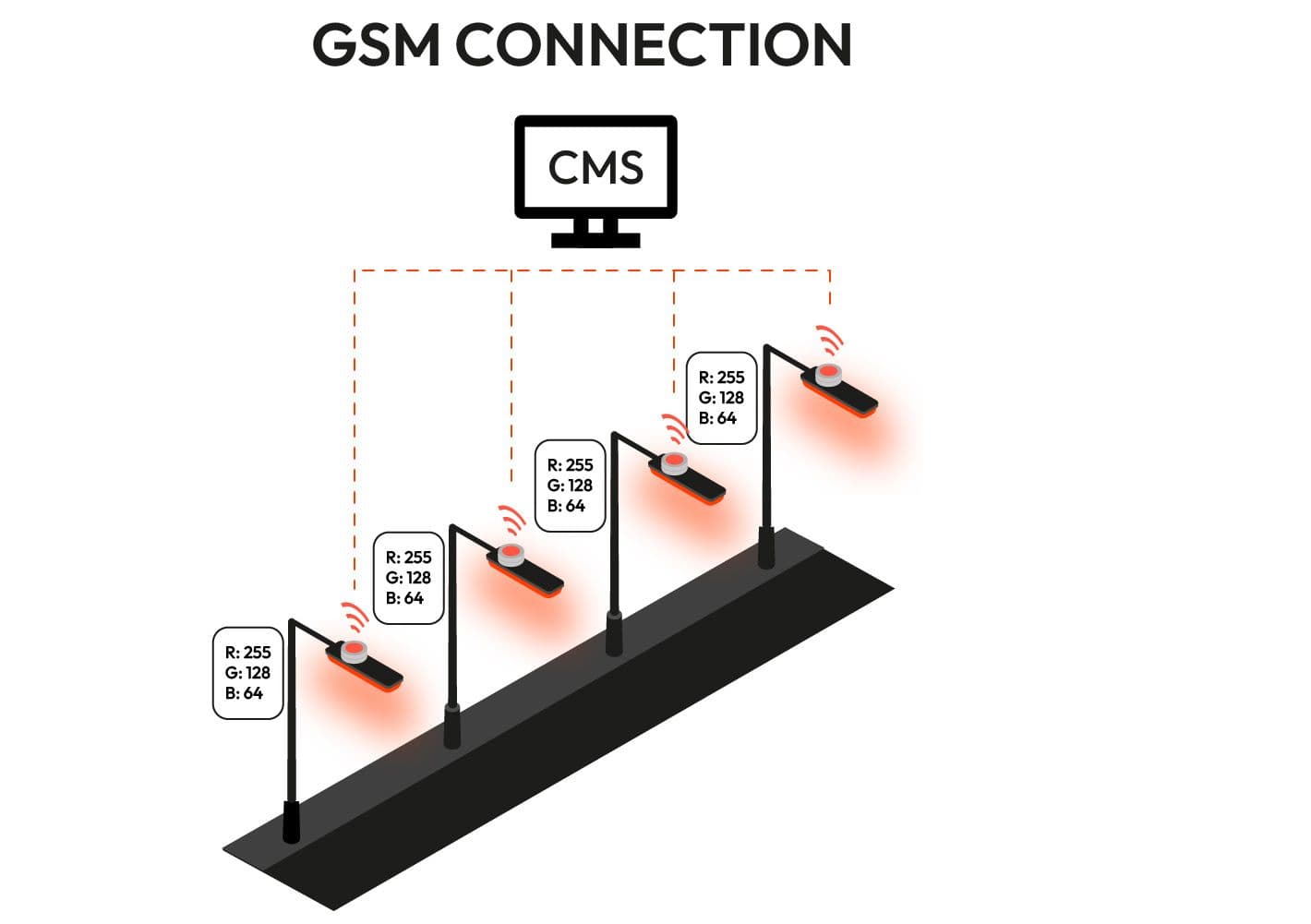
GSM-Based Controllers with GPS Synchronization
If the lighting system is already installed and cable installation is not possible, GSM architecture offers an excellent wireless alternative:
- Each controller receives its scenario and schedule directly
- Local execution — no dependency on neighboring units
- GPS-based synchronization guarantees aligned scene playback, even across long distances
- Private APN options provide secure, isolated data transmission
In terms of budget, the GSM solution is approximately 10 times more affordable than fiber — while still delivering precise, scalable control.
This approach is particularly well-suited for modernizing existing projects or situations where trenching is technically or economically unviable.
Conclusion
Lighting control is about much more than simply switching things on. When architectural or decorative scenes are involved, accuracy, smoothness, and perfect synchronization become mission-critical.
There’s no “one-size-fits-all” protocol — instead, it’s about matching the infrastructure to the task.
Long-distance RGB control: Architecture comparison
| Architecture option | How it works | What it’s good for | Main weaknesses / failure modes | Best fit project stage |
| Device-to-device retransmission (hopping / cascading wireless DMX) | One controller receives the signal and passes it to the next; master coverage ~300–500 m; each hop adds ~100 m; after 3–4 hops delays and loss increase | Simple actions (on/off, dimming) over limited extension | Cumulative delay; packet loss / command distortion; RGB scenes fall out of sync; animations degrade/fail | Only when distances are moderate and scenes are not demanding |
| Fiber optic infrastructure (DMX / Art-Net / sACN over fiber) | Install fiber along the route; supports DMX, Art-Net, sACN; interference-immune and synchronized | Best technical quality for dynamic scenes across kilometers; stable continuous operation | Requires groundwork/materials; higher budget; often not feasible for retrofits | Construction stage / when you can lay control lines with power |
| GSM controllers with GPS synchronization | Each controller receives schedule/scenes directly; local execution; GPS sync aligns playback; optional private APN for isolated comms | Retrofit-friendly long-distance control with aligned scene playback; scalable without neighbor dependency | Depends on mobile connectivity (implicit); not described as “immune” like fiber | Existing installations where trenching/cabling is not possible |