Media Façade vs Architectural Lighting: Choosing the Right Control Architecture
Understanding the difference between media and architectural façades
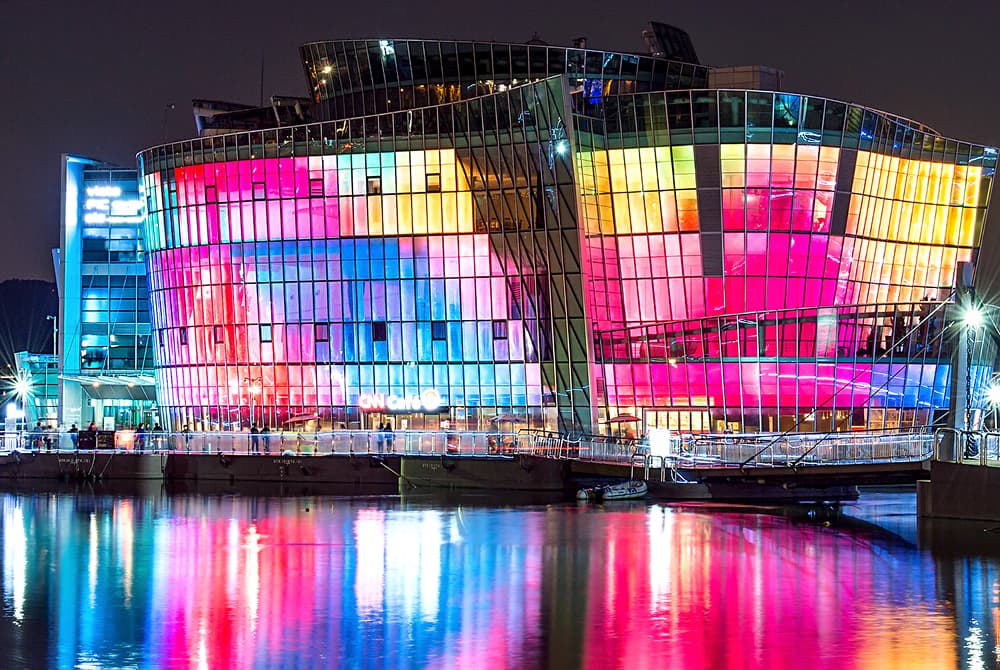
Designing a media façade or architectural lighting system starts with one critical question: what control architecture should you use?
(New to the concept? Start with our overview of what media façade lighting is before diving into architecture and protocol choices below.)
In most façade projects, the backbone is Ethernet-based (Art-Net or sACN), distributing control data across the building. The key architectural decision is made at the output layer: whether to use DMX-based fixture control or SPI-based pixel control.
This choice directly affects refresh rate, signal integrity, power distribution, maintenance strategy, and long-term reliability.
Media façades (pixel-based systems) often rely on SPI or hybrid architectures, while architectural façades (fixture-based systems) typically use DMX and RDM for robust signal transmission and diagnostics.
This guide explains how to choose control architecture for media and architectural façades, comparing DMX vs SPI, centralized vs edge control, hybrid systems, refresh performance, power injection strategy, and economic trade-offs — from a practical engineering perspective.
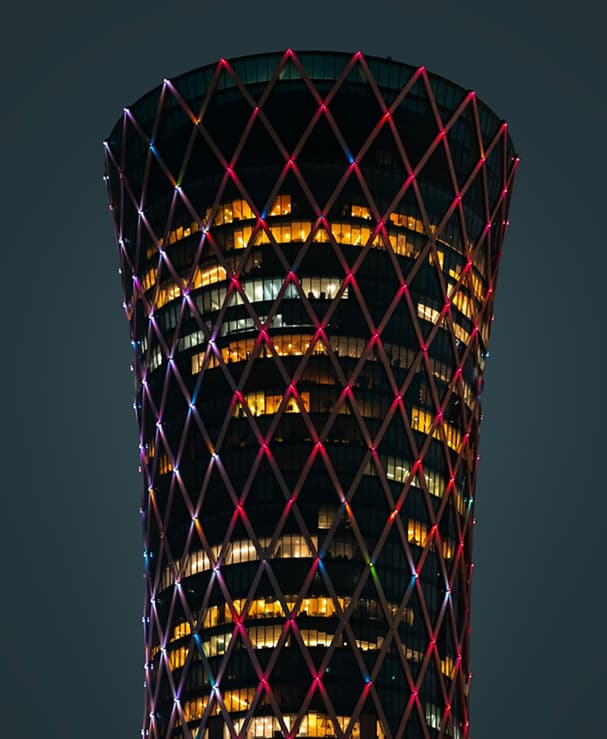
Media façade vs Architectural lighting: Defining the façade type
The first step in system design is not choosing a protocol — it’s defining the type of façade:
Architectural lighting façades
- Emphasize structure, texture, and form.
- Use distributed fixtures (wash, spots, linear) at varying distances.
- Lighting units are often rated for exterior environments and maintainable.
Media façades (pixel-based façades)
- Aim to present continuous imagery, animation, or video-like content.
- Consist of densely placed pixels or LED modules forming a regular grid.
- Visual continuity across the surface matters more than individual fixture location.
DMX512 and Art-Net: Reliable architectural control
DMX512 (ANSI E1.11) is a long-established protocol for lighting control, widely used in architectural and theatrical contexts. It sends up to 512 channels per universe over a differential pair (RS-485). Differential signaling provides noise immunity and controlled common-mode rejection over long cable runs. Typical implementations under proper termination can reliably span hundreds of meters.
Art-Net is a protocol that encapsulates DMX over Ethernet (UDP), allowing many DMX universes to be transported across standard network infrastructure.
Remote Device Management (RDM, ANSI E1.20) enables two-way communication — a controller can query status, defects, and settings from a fixture. RDM is commonly leveraged in architectural lighting systems for installation verification and remote diagnostics.
Key behaviors: DMX + Art-Net networks scale via Ethernet backbones. RDM provides maintainability and live status, important on large buildings.
Notes: RDM requires compliant devices and enabled network switches (IGMP/RDM pass-through).
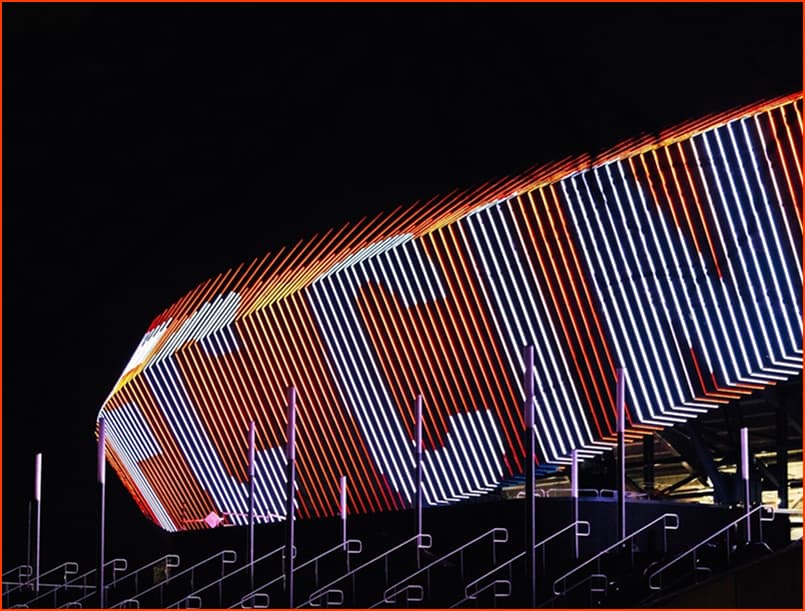
SPI: Pixel-level control for media effects
SPI (Serial Peripheral Interface) is a low-level serial data interface widely used in embedded electronics. In lighting systems, SPI-based LED drivers use a clocked data stream, where timing is defined directly by the controller rather than by a shared network or protocol stack.
In lighting, variants of SPI (e.g., WS2811, SK6812) address pixels individually in a chain (one frame buffer per pixel). Pixels interpret data locally and pass the remaining stream downstream (daisy-chain). This mechanism is not a network protocol — it’s a point-to-point serial stream.
Consequences for façades:
- Per-pixel addressing enables complex animations and gradients.
- Typical SPI signaling (single-ended relative to ground) lacks noise immunity over long distances; signal integrity degrades over meters without buffering.
- Therefore, SPI controllers are placed close to pixel groups; repeaters/buffers or differential converters are used where longer distances are unavoidable (industry practice).
SPI is chosen when the façade must behave visually like a display canvas, with each pixel treated as a discrete element.

Economic trade-offs: Pixel density vs DMX channel capacity
In practice, one reason SPI systems are cost-effective is higher pixel density per controller port. For example, with 8 outputs:
- A typical Art-Net → SPI controller can drive on the order of thousands of pixels (up to 2736), depending on refresh requirements and hardware.
- An Art-Net → DMX converter with 8 universes supports 8 × 512 channels = 4096 channels, which corresponds to fewer RGB pixels when each pixel uses 3 channels (≈ 1365 RGB pixels).
This means that, at equivalent port counts, SPI often addresses more pixels without adding universes, reducing:
- number of controllers,
- racks/cabinets,
- cabling infrastructure.
And because pixel tapes/modules tend to be lower cost per luminous point than robust architectural fixtures, total bill of materials can lean economically toward SPI for dense media façades.
Refresh rate and visual performance
Perceived motion quality depends on refresh rate. DMX512’s transport and update model yields effective refresh rates that, under heavy loads, hover in the low dozens of hertz. Raising refresh rate typically requires reducing universe loads or deploying multiple parallel universes, which increases complexity.
SPI systems can update pixel data at a higher effective rate (tens of kilobits per output line) for the same number of pixels, enabling:
- smoother motion,
- reduced flicker,
- better performance when captured on video.
Many mobile cameras and social platforms capture at 30–60 fps or higher. When lighting refresh correlates poorly with camera capture, temporal artifacts (bands, strobing) appear.
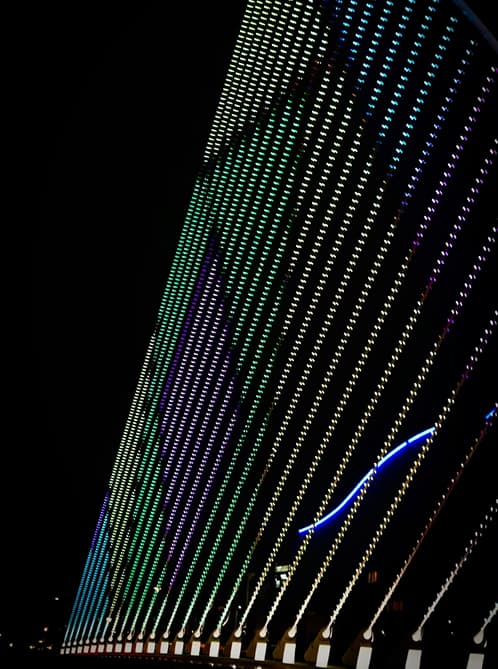
Signal integrity and power injection in DMX and SPI façade systems
Signal integrity:
Differential RS-485 (used by DMX) rejects common-mode noise and supports long runs with proper termination. Single-ended SPI suffers voltage drop and distortion over distance; repeaters or differential conversion are used where longer runs are unavoidable.
Power injection:
SPI pixels are active loads. Voltage drop along long runs causes uneven brightness and color shifts (e.g., white skewing toward red/green) due to resistive losses (Ohm’s law). Regular power injection points (industry often every 5–10 m, depending on gauge and supply voltage) mitigate this.
Controller placement:
SPI controllers are typically distributed close to loads. DMX/Art-Net nodes can be centralized or distributed with less stringent proximity constraints.
Reliability and diagnostics: SPI Pixel chains vs DMX + RDM
SPI systems:
Bus architecture (e.g., WS281x) carries data sequentially. A failed pixel can disrupt downstream pixels unless designs incorporate redundancy/protection (e.g., alternate data paths, backup lines).
Native diagnostics for SPI pixels are limited; failures are often detected visually in commissioning or operation.
DMX + RDM systems:
RDM supports live diagnostics: response status, lamp failures, PSU errors, address checks, etc.
Architectural luminaires are generally designed for outdoor service environments (IP ratings, thermal handling).
Engineering teams should weigh operational maintenance costs and reliability expectations when choosing architecture.
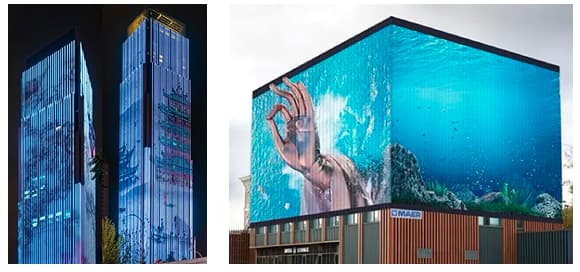
Façade control architecture decision checklist (DMX, SPI, Hybrid)
Rather than default to a protocol, ask:
- Is the façade intended to behave as a coherent visual canvas? Yes → pixel-centric control.
- Are there extensive architectural breaks (windows, niches, long cable runs)? Yes → consider differential signaling and robust networking.
- Is long-term serviceability and remote diagnostics required? Yes → favor architectures supporting two-way monitoring.
- Does project budget favour maximum pixels per hardware unit? Yes → dense pixel systems may be cost-effective, but account for installation complexity.
Art-Net often acts as a backbone:
- Art-Net → DMX for architectural fixtures,
- Art-Net → SPI for pixel clusters.
This hybrid approach is common in large installations.
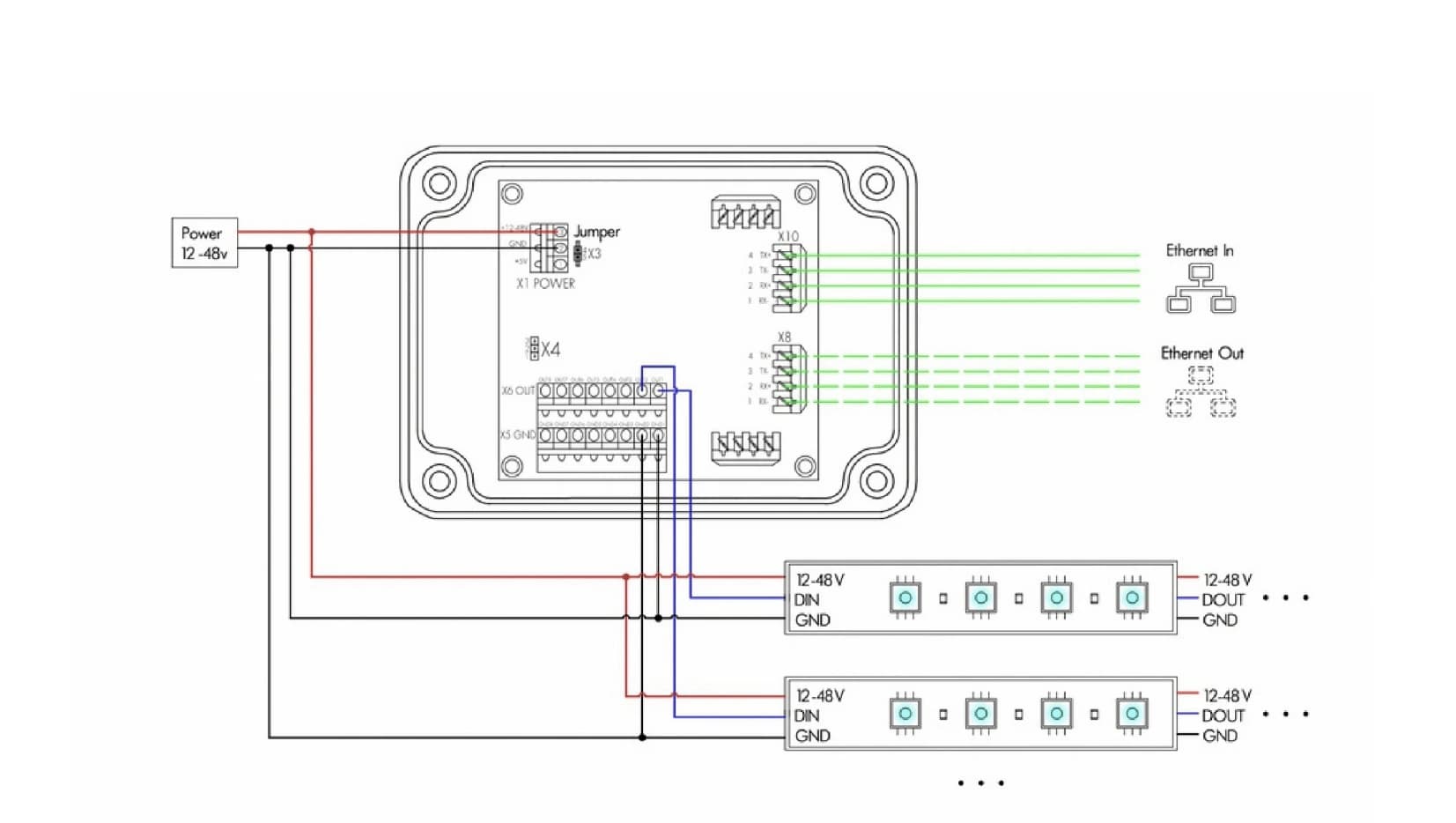
From control architecture to hardware implementation
The architectural principles described above are not theoretical — they are reflected directly in how control hardware is selected and deployed on real façades. Two typical examples illustrate how architectural and media façade requirements translate into specific device roles.
SPI controllers for pixel-based media façades
In pixel-based media façades, SPI controllers are usually placed close to the LED load to minimize signal degradation and simplify power distribution. This is where compact, outdoor-capable edge devices are required.
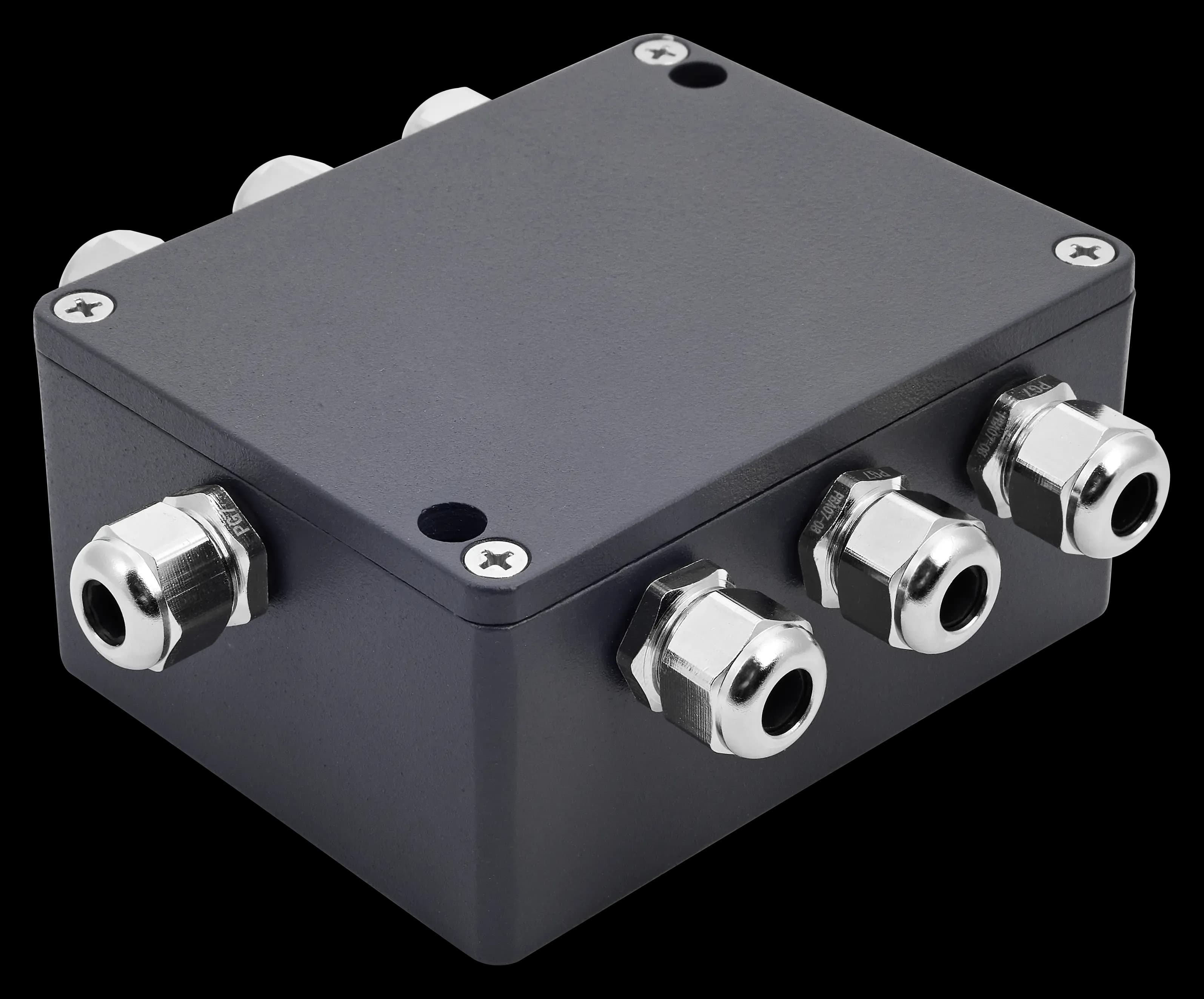
A typical example is DITRA PixelGate Shield or PixelGATE Rail— a pixel controller designed to operate directly at the façade edge. It converts Art-Net data from the Ethernet backbone into SPI signals for pixel lines, while addressing the key constraints discussed earlier in this article:
- short SPI signal paths,
- distributed controller placement,
- operation in outdoor or semi-outdoor environments,
- reduced cabinet count for dense pixel installations.
Such devices are commonly used in façades that behave as a continuous media canvas, where pixel density and refresh performance are primary design drivers.
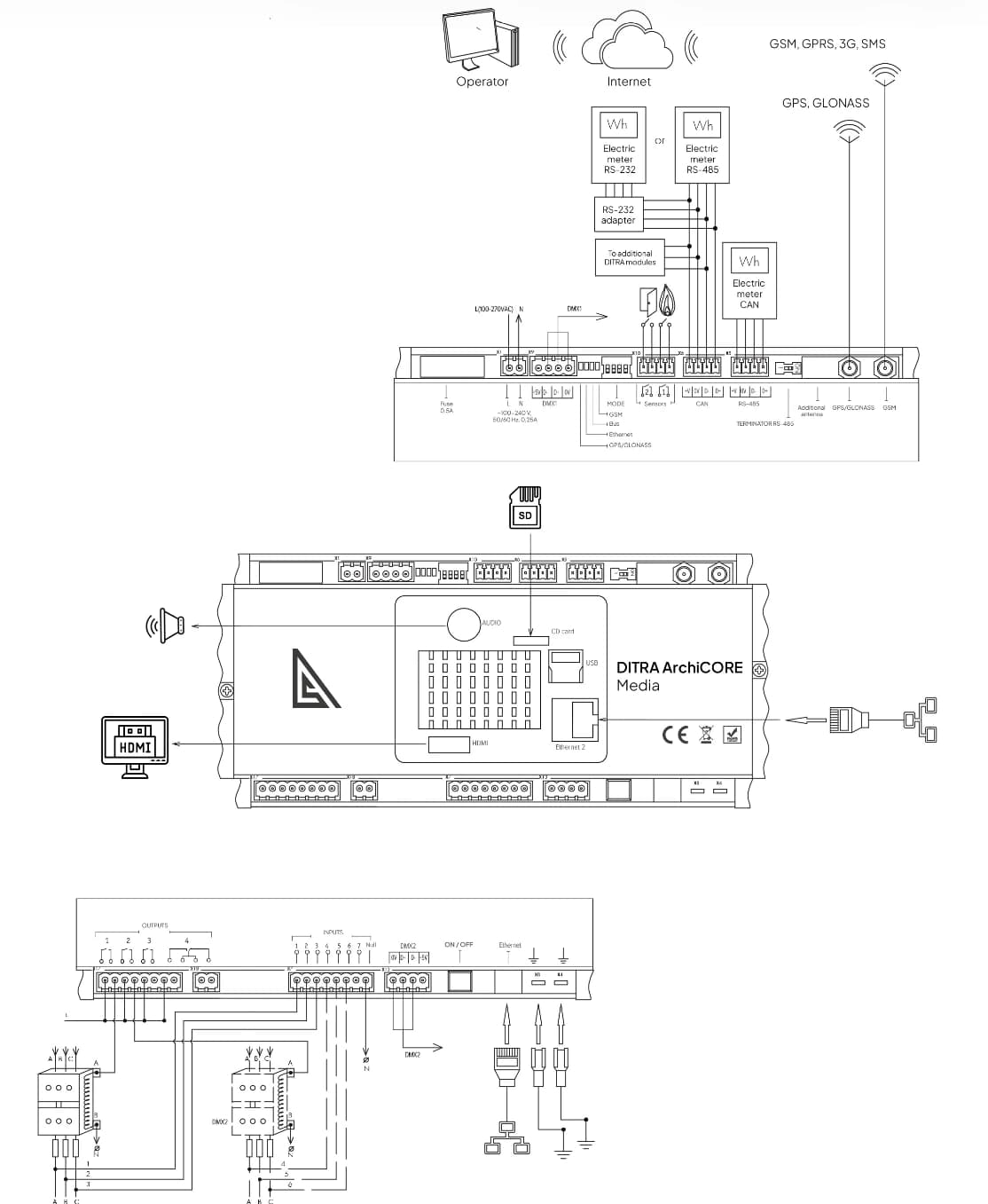
Central control for architectural and media façades
While edge devices handle pixel or fixture output, large façades also require a central controller responsible for coordination, system logic, and integration.
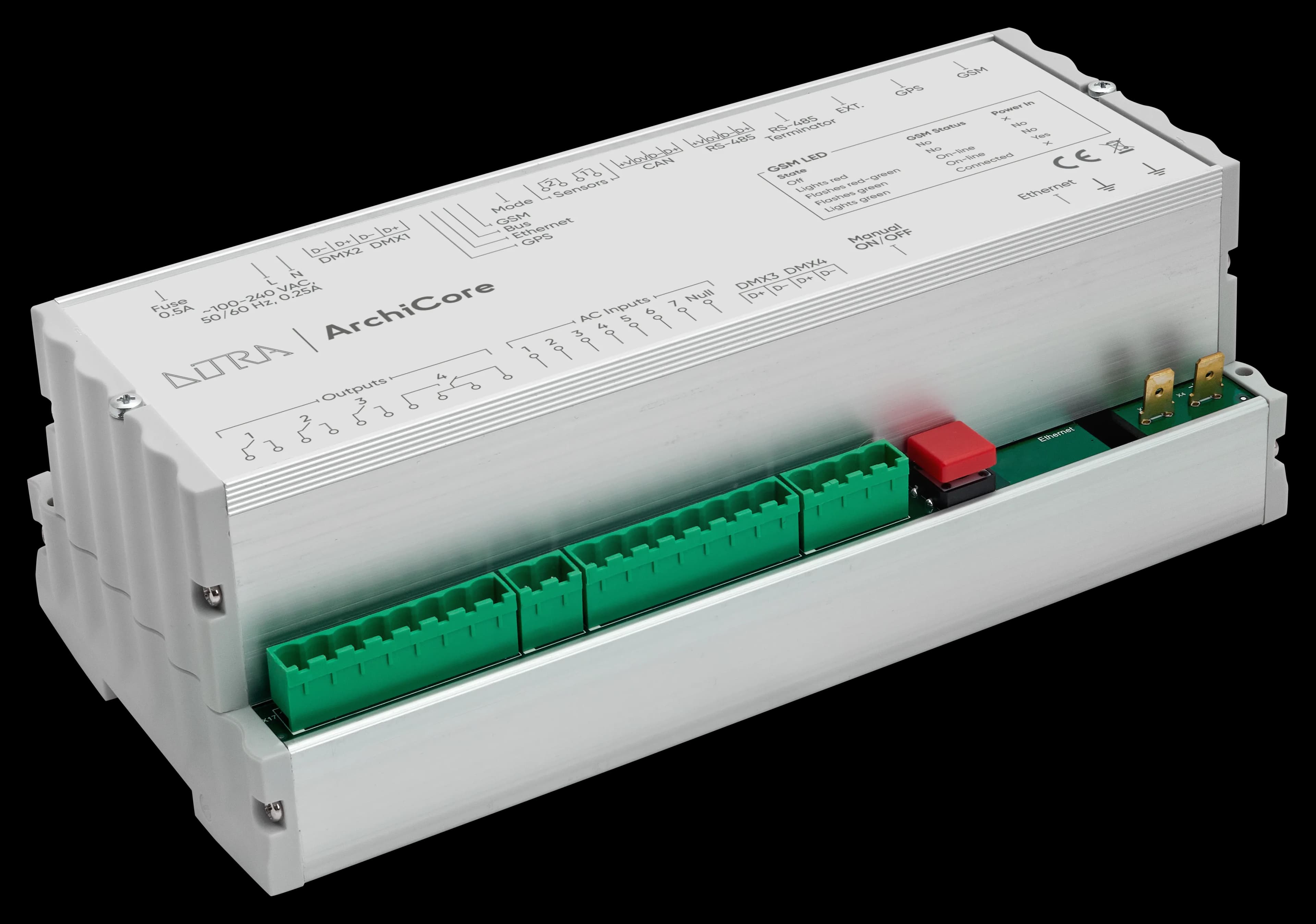
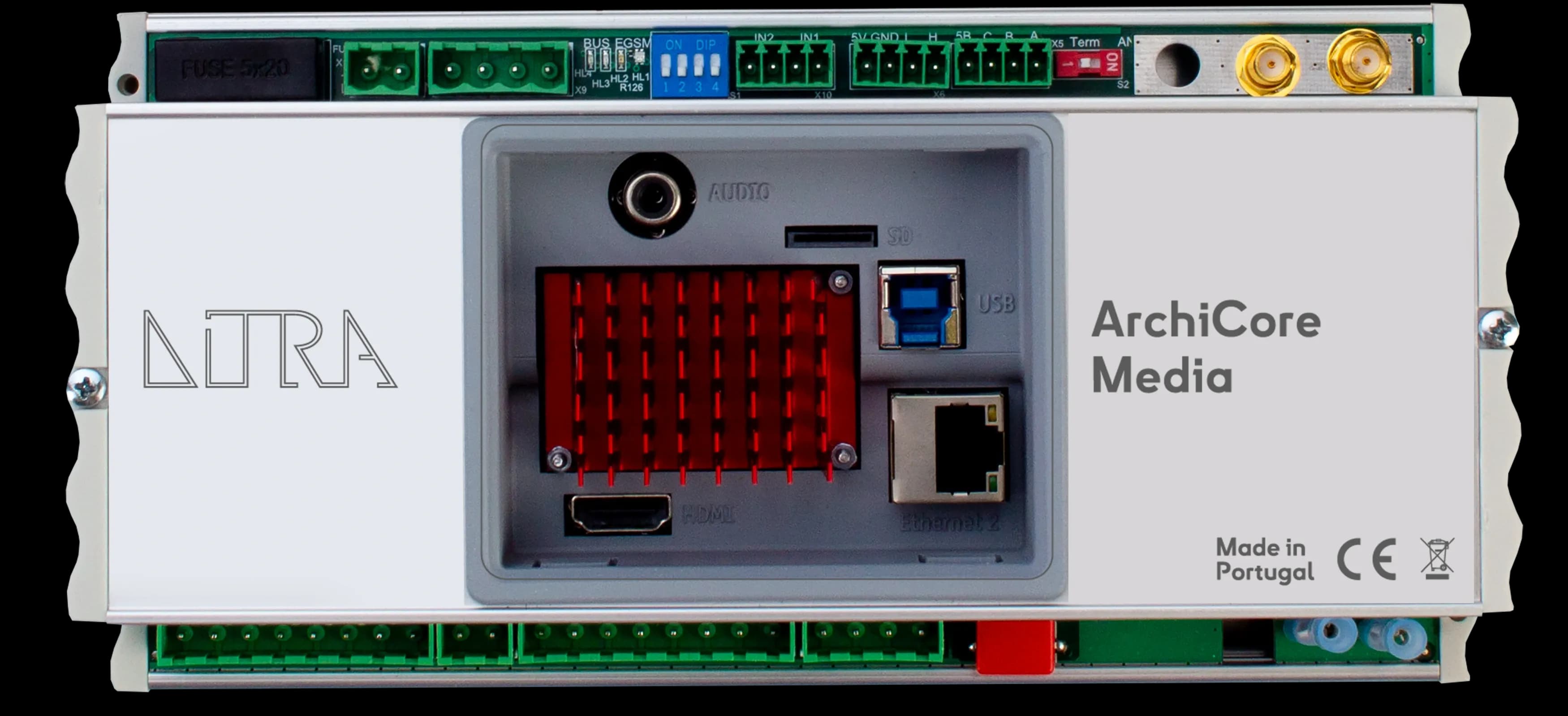
In DITRA-based systems, this role is typically performed by DITRA ArchiCORE Media — the central controller of the DITRA system, designed for managing architectural lighting while also handling audio and video content. From an architectural standpoint, ArchiCORE Media functions as the system brain, providing:
- centralized control of architectural lighting,
- playback and synchronization of media content,
- support for two independent DMX512 streams,
- interfaces for external systems and field devices (RS-485 / MODBUS, CAN),
- sensor inputs and acknowledgment feedback,
- dual Ethernet interfaces for network redundancy,
- integrated GSM (3G/4G) communication and GPS/GLONASS positioning.
Additional interfaces such as HDMI, RCA, and SD card support allow the controller to operate as a media-capable control node, rather than a pure lighting gateway.
The device is DIN-rail mounted, designed for outdoor or semi-outdoor installation (IP23), and powered from a wide AC range — making it suitable for placement in façade control cabinets or technical zones.
Explore DITRA's media façade control solutions to see how these architectures are implemented in complete, project-ready systems.
Hybrid control architectures for façades
In large-scale projects, architectural and media façade approaches are often combined within a single system. A common implementation pattern is:
- ArchiCORE Media as the central controller and coordination layer,
an Ethernet backbone (Art-Net) distributing control and media data, - PixelGate Shield units serving dense SPI pixel areas close to the façade,
DMX-based luminaires used where architectural accents, robustness, and serviceability are required.
This hybrid architecture allows each façade zone to use the control method best suited to its visual and operational requirements — without compromising overall system coherence, maintainability, or scalability.
DMX/RDM vs SPI vs Hybrid: Which façade control architecture fits your project?
| Project requirement / constraint | Best fit | Why | Watch-outs (implementation risks) |
| Façade must behave like a visual canvas (animations, gradients, “video-like” effects) | SPI / Hybrid | Per-pixel addressing enables dense media effects and continuity. | Keep SPI paths short; plan buffers/repeaters; place controllers close to loads. |
| High pixel density with fewer controllers | SPI | SPI controller can control more pixels than a DMX system without increasing the number of universes. | Power injection + voltage drop planning; PSU sizing; thermal constraints. |
| Long-term serviceability + remote diagnostics required | DMX + RDM | Two-way communication supports status and fault visibility. | Ensure RDM-capable devices; validate switch/network behavior for RDM traffic. |
| Long cable runs and/or high EMI environment | DMX | RS-485 differential signaling is more noise-immune over distance (with termination). | Termination/topology discipline; use proper splitters; avoid unmanaged star wiring. |
| Many architectural breaks (windows, niches, separated zones) | Hybrid | Each zone can use the most suitable method for distances and intent. | More integration + commissioning effort. |
| Discrete fixtures (wash/spots/linear), not a dense pixel grid | DMX + RDM | Fixture control + maintainability workflows are a strong match. | Universe/channel planning; maintainable addressing strategy. |
| Camera-friendly output (reduced flicker/banding on video) is important | SPI (often) / Hybrid | Higher effective update rates are often feasible for pixel content. | Validate refresh vs pixel count; test with target cameras and typical scenes. |
| Need central coordination plus distributed edge outputs | Hybrid | Ethernet backbone distributes data; edge devices output DMX or SPI locally. | Network design + redundancy; consistent commissioning workflow. |
| Minimize cabinet/rack footprint for dense media sections | SPI / Hybrid | Distributed edge controllers reduce central conversion racks/cabinets. | Outdoor enclosure/service access; environmental and maintenance constraints. |
| Failure impact must be contained (no single fault killing large area) | DMX + RDM / Hybrid | Fixture networks/zoning can isolate failures better. | SPI daisy-chain failure modes; mitigate via segmentation/redundancy where applicable. |
| Budget constrained, but the look must be “media-like” | SPI / Hybrid | Potentially fewer controllers/universes for the same visual density. | Install complexity can eat savings; cost power distribution + commissioning time. |
| Mixed façade: architectural accents + media areas in one system | Hybrid | DMX for robust fixture zones + SPI for dense pixel zones, on one backbone. | Define sync/timing responsibilities; keep naming/addressing consistent across zones. |