Can RGB/RGBW luminaires be controlled via DALI? Why is DMX usually preferred?
DMX vs DALI for RGB and RGBW lighting control
RGB and RGBW luminaires can be controlled using both DALI and DMX protocols, but their capabilities and limitations differ significantly. The choice depends on the number of fixtures, required refresh rate, and whether dynamic lighting effects are needed.
In this article, we compare:
- how RGB/RGBW control works with DALI and DMX,
- channel and address limitations of each protocol,
- refresh rate and synchronization differences,
- when DALI is sufficient and when DMX is the better choice.
RGB and RGBW control with DALI vs DMX: key differences
This is one of the most common questions we receive from architects and engineers: “Can we control RGB or RGBW LEDs via DALI? Or do we need to go with DMX from the start?”
In short: Yes, you can control RGB/RGBW with DALI — but if you’re doing anything more than static lighting, DMX is almost always the better choice.
Let’s break it down by numbers.
Addressing limitations for RGB and RGBW luminaires:
- DALI supports up to 64 addressable devices per line.
An RGBW fixture will consume up to 4 addresses (one per channel: R, G, B, W). → That means you can only control 16 RGBW luminaires per DALI line before hitting the limit. - DMX allows 512 channels per universe (line).
- An RGBW luminaire still takes just 4 channels, but is treated as one device under centralized control. → So you can connect up to 128 RGBW luminaires per DMX line.
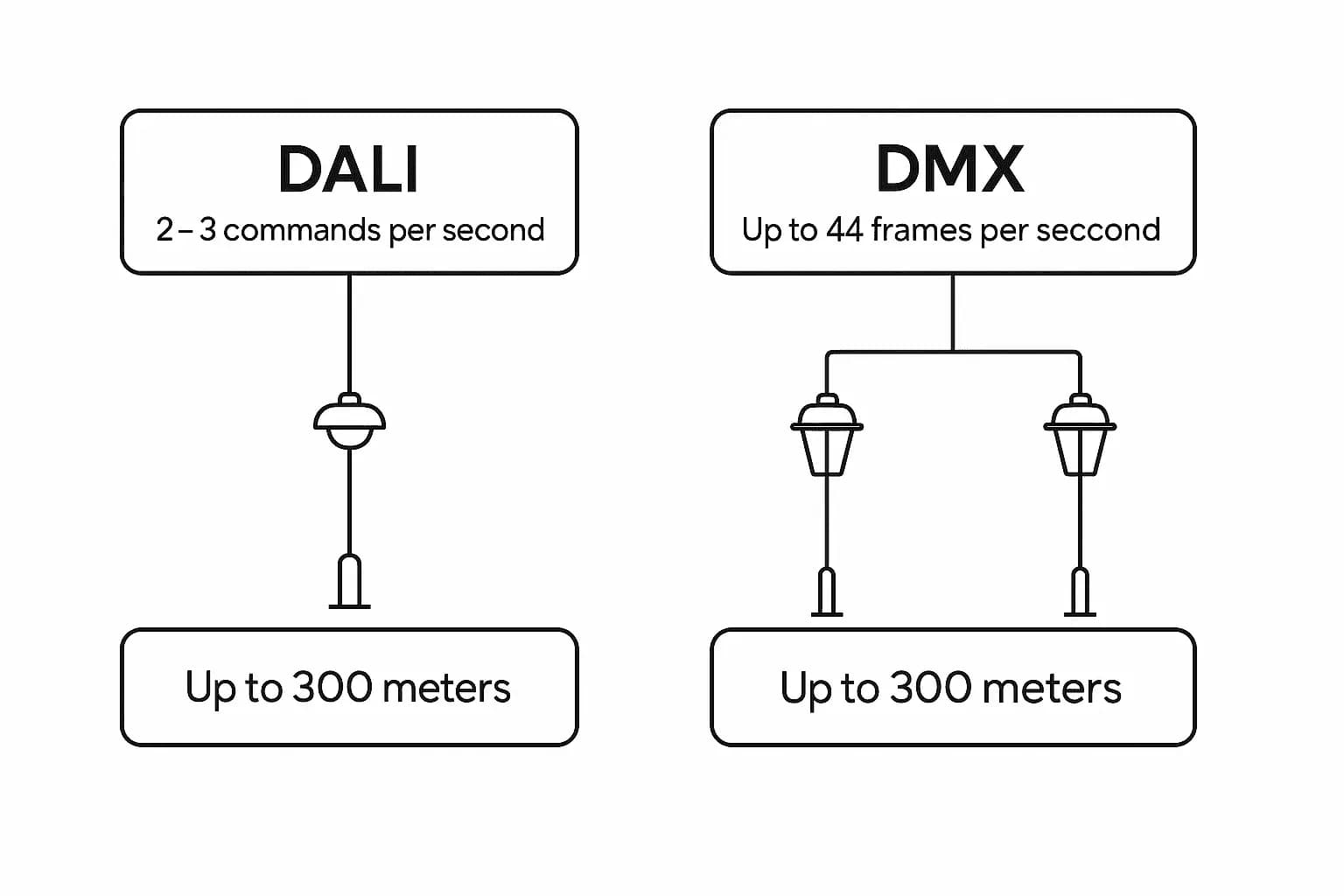
Refresh rate:
- DALI sends commands slowly — about 2–3 commands per second. → Fine for on/off, smooth dimming, or occasional color changes. → But any dynamic scenes will appear choppy and out of sync.
- DMX updates up to 44 frames per second, continuously refreshing all channels. → Perfect for animations, gradients, and lighting shows — all in perfect sync.
Line length:
- DMX supports line lengths of up to 300 meters without repeaters, assuming shielded cables are used.
- DALI is also limited to about 300 meters, but it’s more vulnerable to interference — especially with complex topologies or outdoor environments. → DALI also sends power and data over the same wires, which can require extra care in street installations.
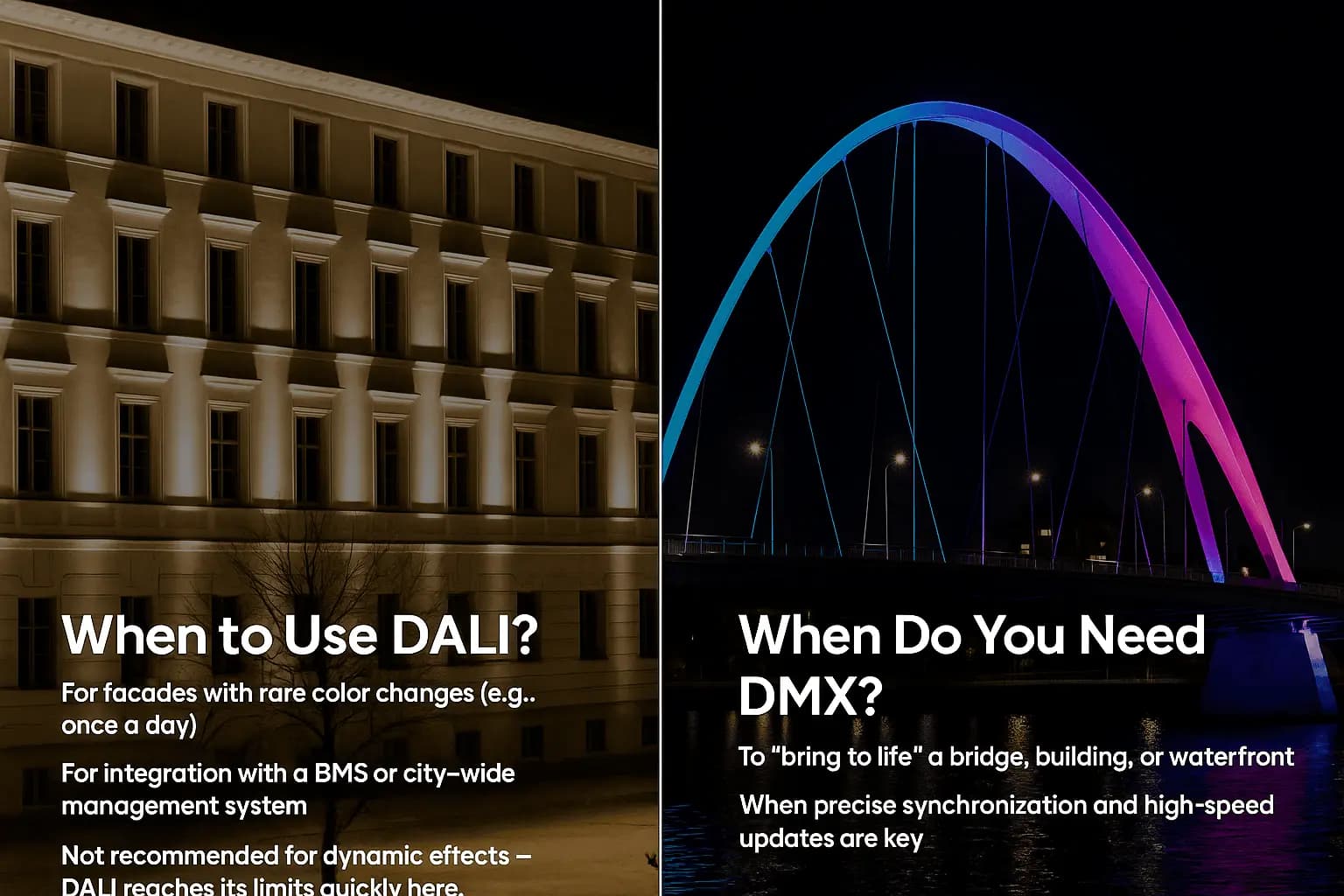
When DALI can be used for RGB/RGBW lighting?
- For facades with rare color changes (e.g., once a day).
- For integration with a BMS or city-wide management system.
Not recommended for dynamic effects — DALI reaches its limits quickly here.
When DMX can be used for RGB/RGBW lighting?
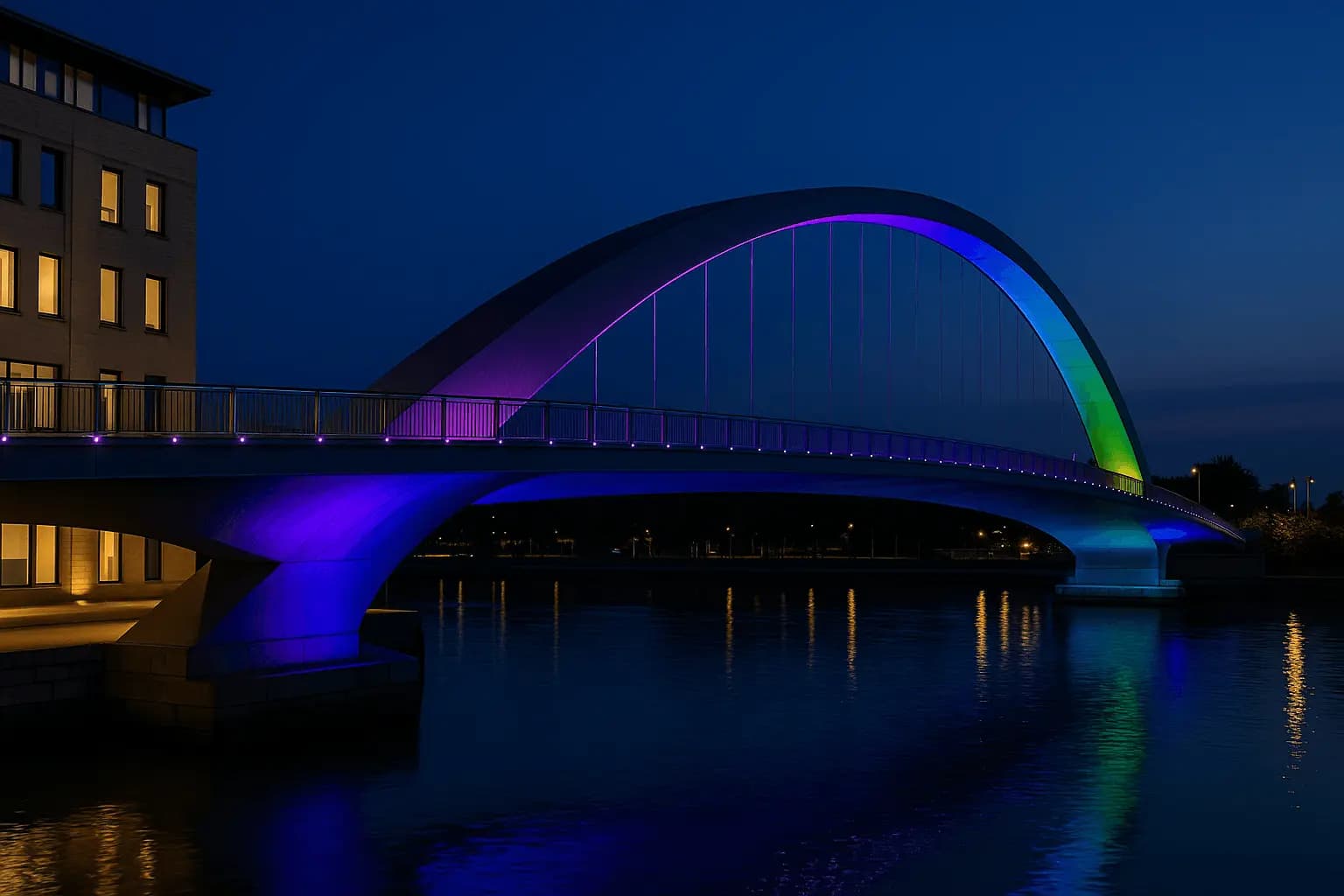
- To “bring to life” a bridge, building, or waterfront.
- When precise synchronization and high-speed updates are key.
- When there are many RGBW fixtures and you need scalable, flexible control.
Choosing between DALI and DMX? Get in touch — we’ll help you find the best solution for your goals, budget, and architectural needs.
DMX vs DALI for RGB/RGBW: Key takeaways in one table
| Criterion | DALI | DMX | What it means for RGB/RGBW projects |
| Can it control RGB/RGBW? | Yes | Yes | Both can, but they behave very differently once you need dynamics. |
| Max RGBW fixtures per line | ≈ 16 RGBW fixtures per DALI line (64 / 4) | ≈ 128 RGBW fixtures per DMX universe (512 / 4) | This is the core scalability difference. |
| Refresh / update speed | ~2–3 commands per second | Up to 44 frames per second | DALI suits static or occasional changes; DMX suits smooth animation and tight sync. |
| Synchronization for scenes | Limited for dynamic scenes | Strong, continuous refresh | DMX keeps all channels in sync for gradients/animations; DALI can look choppy. |
| Typical line length | ~300 m | Up to ~300 m (shielded cable, no repeaters) | Similar headline distance, but different robustness assumptions. |
| Robustness / interference sensitivity | More vulnerable in complex topology / outdoor; power+data share wires | More stable over distance with correct cabling | DALI needs more care in “street/outdoor” style installs. |
| When it’s “enough” | Rare color changes (e.g., once/day); BMS / city system integration | — | DALI fits building-management-oriented use and mostly-static RGBW. |
| When it’s preferred | — | Dynamic effects; precise sync; many fixtures; scalable control | DMX is positioned as the default for anything beyond static lighting. |