How to estimate the cost of a Smart Street Lighting Control System
Understanding the main cost components and calculating cost per luminaire

Last updated: 11 June 2026 / 5 min read
Author: Valdo Baldwin
When evaluating smart street lighting solutions, many comparisons focus on the price of nodes or gateways. In engineering practice, however, hardware represents only one part of the overall project cost.
From a total cost of ownership (TCO) perspective, software, communication infrastructure, commissioning activities, licensing models, and long-term technical support can have as much impact on project economics as the controllers themselves.
As a result, two projects using similar hardware may differ significantly in cost per luminaire.
This article explains the major cost components of a smart street lighting control system and presents a practical approach to estimating the overall cost per luminaire.
Key takeaways
- Node prices alone do not represent the total cost of the system.
- Similar hardware can result in very different lifecycle costs.
- Driver selection can significantly influence project economics.
- Software and communication models vary between vendors.
- Cost per luminaire provides a more objective basis for comparison.
- Total cost of ownership should be evaluated over the expected lifetime of the system.
Why comparing node prices can be misleading
Engineering practice shows that different manufacturers distribute system costs differently.
In some systems, a large portion of the cost is concentrated in the control nodes. In others, drivers account for a significant share of the overall budget.
Software can also be delivered in different ways:
- included in the system price;
- purchased through a perpetual license;
- provided under a subscription model.
As a result, a solution with more expensive nodes may ultimately have lower operating costs than a solution with inexpensive nodes and substantial recurring expenses.
From a total cost of ownership perspective, similar hardware prices do not necessarily translate into similar lifecycle costs.
Why luminaire configuration matters in Smart Lighting Projects
When estimating project costs, it is important to consider not only the control equipment but also the luminaire configuration itself.
One of the most overlooked factors is driver selection.
For example, if the project requires monitoring electrical parameters at every luminaire, Zhaga-based architectures often require D4i drivers.
However, some NEMA controllers are capable of measuring electrical parameters independently and can operate with simpler drivers, including:
- 0–10V;
- DALI-1;
- DALI-2.
Driver selection is often underestimated during the budgeting stage, although it can significantly influence the final project cost.
Depending on the scale of the project, the choice of drivers may become one of the key cost drivers.
Main cost components that should be included
For an objective comparison, DITRA Solutions recommends evaluating all major cost categories rather than focusing on individual components.
| Component | Included items |
| Control nodes | Individual luminaire controllers |
| Drivers | D4i, DALI-1, DALI-2, 0–10V and other driver types |
| Gateways | Data transmission and aggregation devices |
| Software | Management and monitoring platform |
| Licenses and subscriptions | One-time or recurring payments |
| Communications | SIM cards, NB-IoT, LoRaWAN, RF mesh, and other communication channels |
| Commissioning | System setup and commissioning activities |
| Technical support | Updates, maintenance, and service |
In practical deployments, communication infrastructure and ongoing support often have as much impact on project economics as hardware prices.
How DITRA Solutions calculates Smart Street Lighting system cost
Instead of comparing the prices of individual components, DITRA Solutions recommends evaluating the cost of controlling one luminaire over a period of five to ten years.
Based on our experience with different system architectures, cost per luminaire provides a more meaningful benchmark than the price of individual devices.
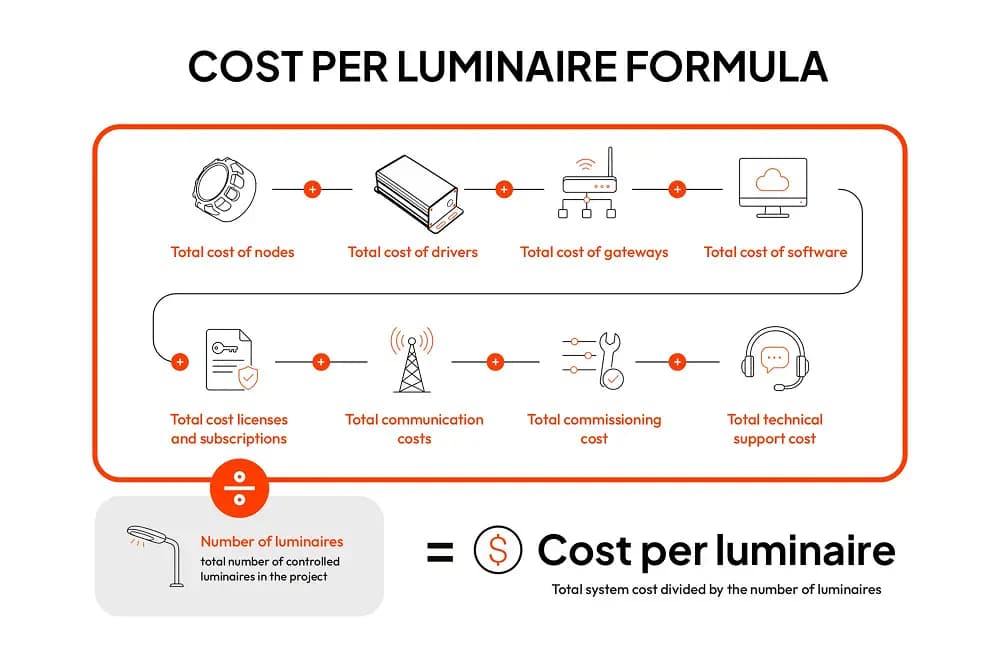
The calculation can be expressed as follows:
Cost per luminaire =
(Total cost of nodes
+ Total cost of drivers
+ Total cost of gateways
+ Total cost of software
+ Total cost of licenses and subscriptions
+ Total communication costs
+ Total commissioning costs
+ Total technical support costs)
÷ Number of luminaires
This approach provides a more realistic representation of total ownership costs and enables objective comparison between different architectures and licensing models.
Conclusion
Node price is only one of many elements that determine the economics of a smart street lighting project.
There is no such thing as a universally "cheap" node. The economics of a smart street lighting system should always be evaluated in the context of the complete architecture.
In our experience, focusing on total cost of ownership leads to more informed technology decisions than comparing hardware prices alone.
For a meaningful comparison of street lighting control systems, it is important to evaluate hardware, software, communication infrastructure, commissioning requirements, and long-term operation together.
Looking at cost per luminaire rather than individual component prices provides a more reliable basis for selecting the most appropriate solution for a specific project.