Smart control for solar street lighting
Solar street lighting control: Choosing the right backhaul (GSM vs LiWAVE)
Solar street lighting is scaling fast worldwide—making control and diagnostics as important as the hardware itself. Without telemetry and remote actions, faults stay invisible and OPEX grows.
This guide explains:
- what the control layer does in solar street lighting systems,
- how GSM and radio (LiWAVE) backhauls differ,
- how to choose the right communication method based on topology and total cost of ownership.
Why remote control matters
Control is essential for collecting telemetry, performing diagnostics, and managing operational modes without sending crews to the installation site.
For example, you will immediately know:
- that the luminaire battery is depleted (needs replacement);
- that the solar panel is not charging (it may be dirty or damaged);
- that the lighting did not turn on according to the schedule (needs urgent correction to ensure safety).
This approach helps reduce the number of site visits and ensure the stable operation of your entire lighting fleet. For this, we offer two solutions: DITRA SOL Mini GSM and DITRA SOL Mini LiWAVE.
What both controllers do
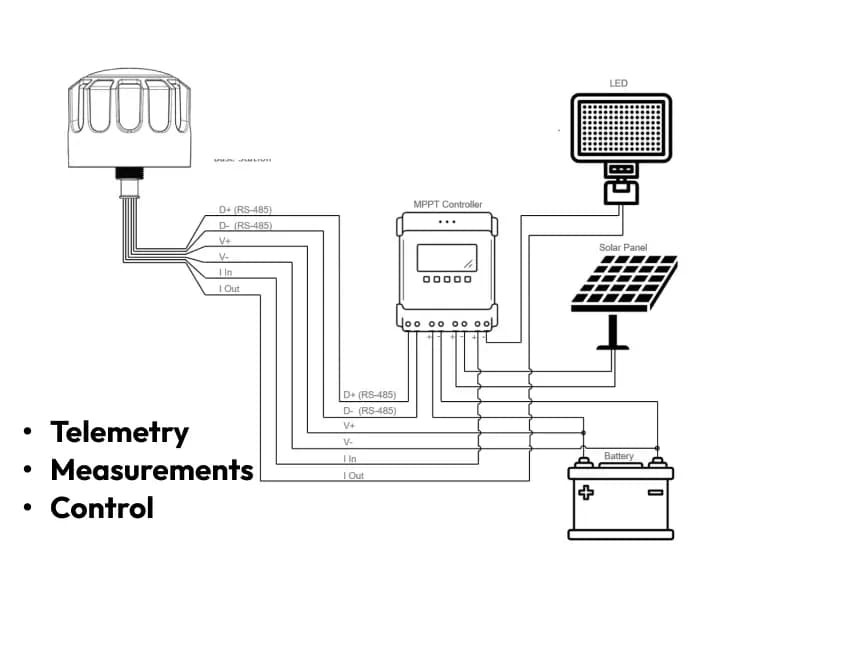
Both devices are the heart of the system. They connect to the MPPT charge controller via the RS-485 interface and provide comprehensive information:
- Telemetry: Battery status, charging process, load consumption.
- Measurements: Accurate data on current (I_in / I_out) and voltage (V+ / V−).
- Control: If your MPPT controller supports external commands, you can remotely change operating schedules or dim the light output. Otherwise, the controller functions solely as a telemetry node, reporting errors to the server.
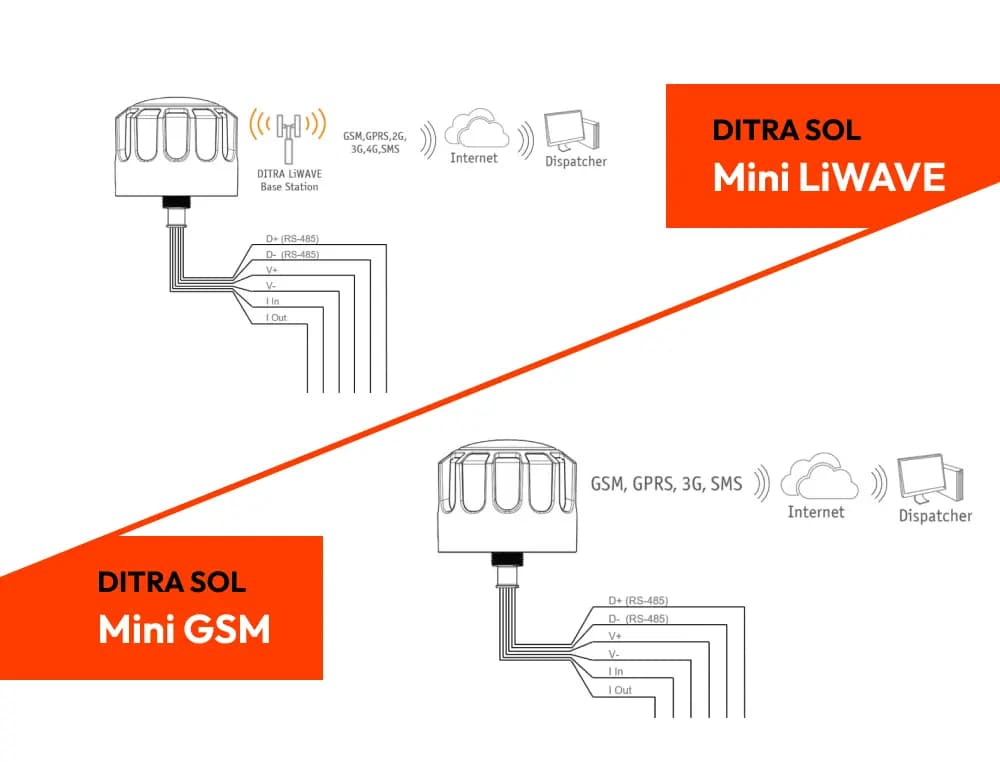
GSM vs radio backhaul in solar street lighting control. The Key difference: The Communication method
The main distinction between the controllers is how they send data to the central management system (CMS).
DITRA SOL Mini GSM: Direct cellular link
- How it works: The controller has a built-in modem (GSM/GPRS/4G) and connects directly to the server via a cellular operator.
- SIM Cards: A SIM card is required in every luminaire.
- Best suited for: Single, remote, or widely spaced luminaires where building additional radio infrastructure is not cost-effective. This is the fastest solution for deployment.
DITRA SOL Mini LiWAVE: Cost-effective radio network (Gateway)
- How it works: The controller (referred to as a node) communicates with the nearest LiWAVE Base Station via a radio link. The Base Station acts as a gateway, collecting the data and connecting to the server via a cellular network (GSM/4G) or a wired Ethernet connection.
- SIM Cards: No SIM card is needed in the luminaires.
- Key advantage: One Base Station can serve dozens, sometimes up to a hundred, nodes. This significantly reduces operating expenses (OPEX) since cellular subscription costs are consolidated to the Base Station.
- Best suited for: Clusters of lights (streets, parks, long roads) where cost-effectiveness and scalability are paramount.
How to choose the right backhaul? Topology and cost
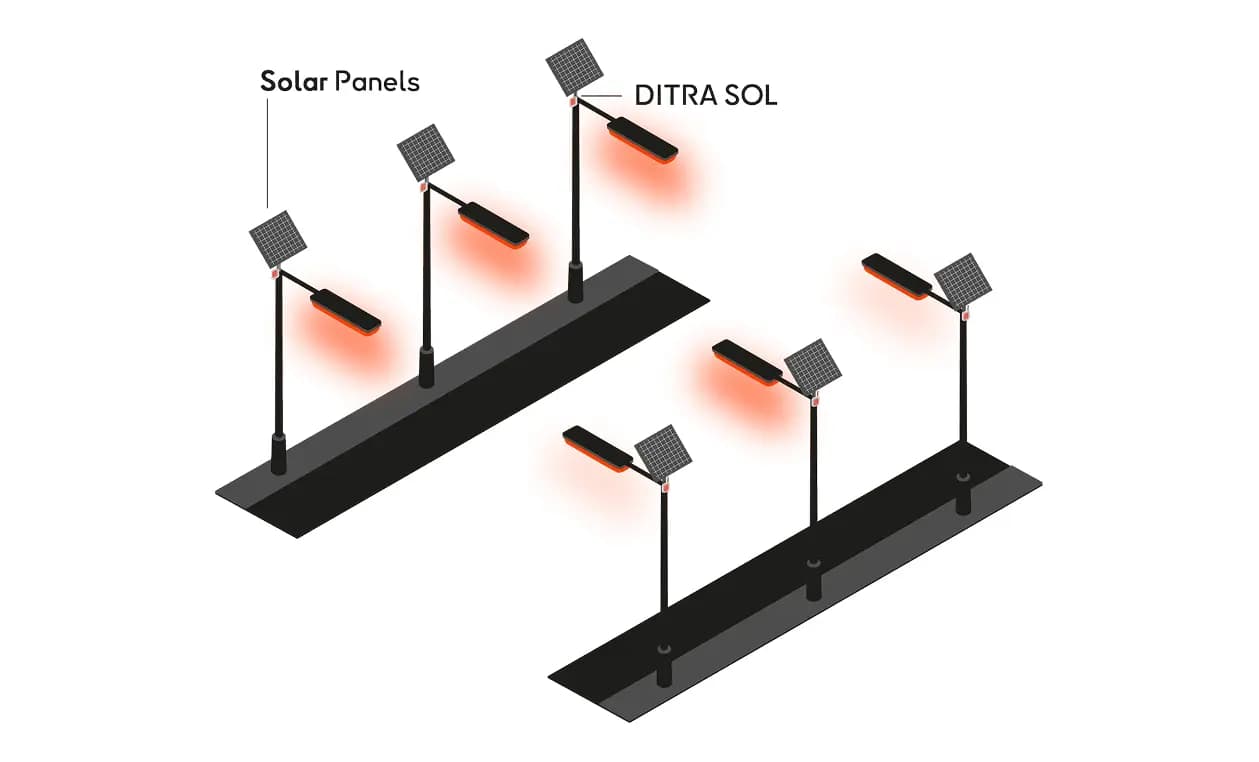
Choosing between the controllers depends on your project's topology and the total cost of ownership (TCO):
- For single, far-apart poles: We recommend DITRA SOL Mini GSM. This avoids the capital investment required for a Base Station.
- For groups of luminaires within coverage: DITRA SOL Mini LiWAVE is optimal. The Base Station purchase is quickly offset by the cost savings realized from the reduced number of cellular subscriptions.
- For dense urban areas: You must verify the LiWAVE coverage. If high buildings severely limit the Base Station's range (e.g., serving only 15–20 luminaires), the GSM solution (direct cellular) may prove more economical in terms of TCO.
Reliability in extreme conditions
Since our controllers operate outdoors, we have ensured maximum protection:
- Operating temperature: They withstand temperature swings from -40°C to +70°C.
- Humidity: The enclosure handles relative humidity up to 100%.
- Protection: The IP67 standard guarantees complete dust-tightness and protection against temporary immersion in water.
By choosing DITRA SOL Mini, you are investing in a reliable solution designed for long-term operation even in the most challenging climatic conditions.