From Smart Street Lighting to a Smart City: How to Start with Existing Infrastructure
Municipal Smart Street Lighting: The First Step Is Control Architecture
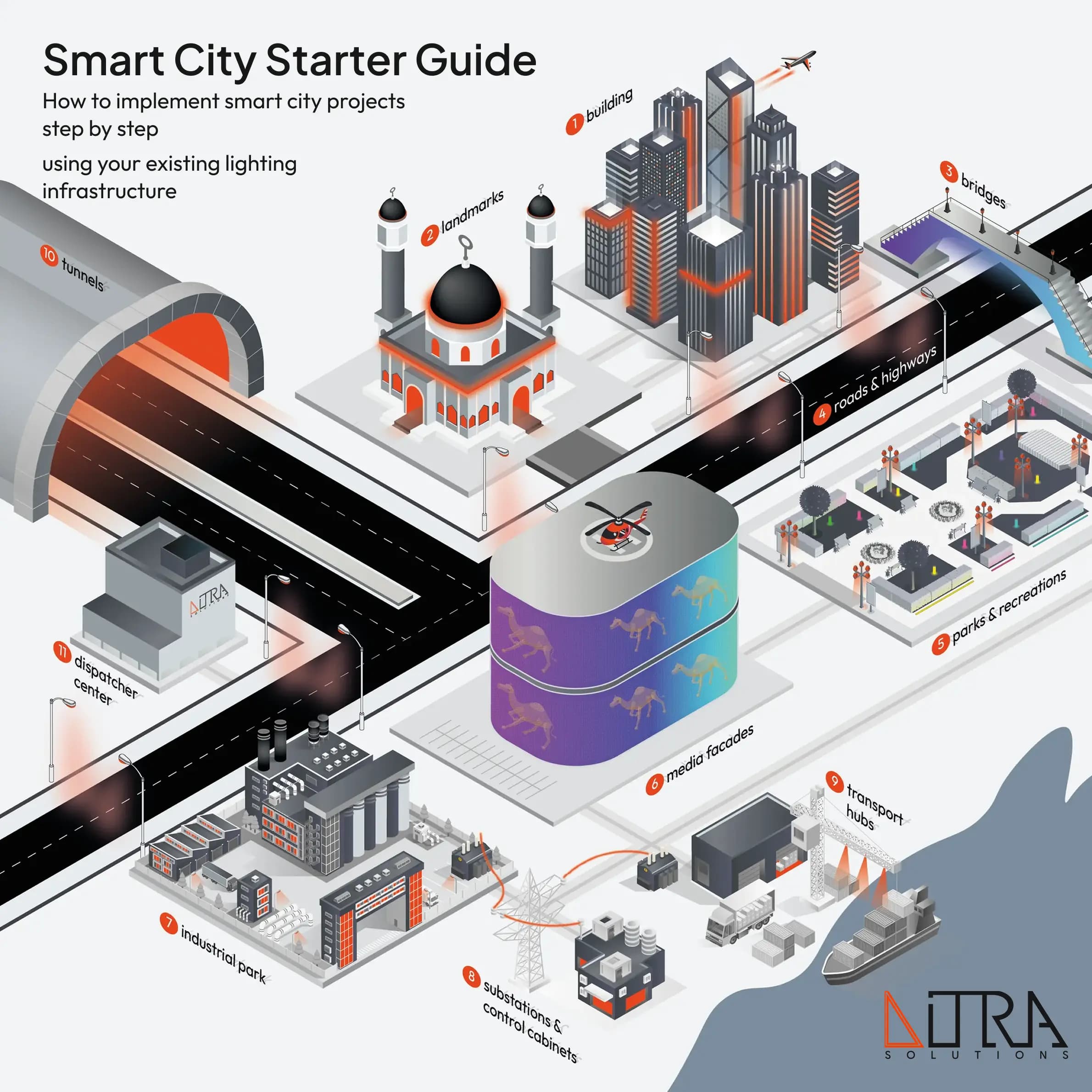
If you're searching for the optimal, scalable, future-proof architecture for municipal smart street lighting, you've likely faced the core dilemma: where to begin? With sensors? With a platform? Or do you need to replace the entire network at once?
In practice, smart city lighting projects often stall not due to a lack of technology, but because of the complexity of the first step. How do you transform hundreds or thousands of streetlights into a manageable, scalable foundation for smart city solutions?
Our new Smart City Starter Guide offers a clear three-step roadmap—without major reconstruction or trying to implement everything at once.
Download the guide "Smart City Starter Guide".
Smart City Starter Guide: The 3 questions that block most projects
The guide is built around key questions asked by municipal teams and integrators:
- "Do we need to replace all our infrastructure?" — No. The guide shows how to start with a pilot on 5-10% of the network and scale from there.
- "Is this only for megacities?" — No. The approach is suitable for medium-sized and even small cities.
- "Is it too expensive and complex?" — On the contrary. Initial results—energy savings, fewer emergency callouts—can offset the starting investment.

Guide overview: The 3 steps (Control architecture → Sensors → Platform)
Choosing the architecture: The foundation for growth
The first section is dedicated to the optimal architecture for lighting control. You will learn:
- How to turn ordinary street lights into a ready-made network for sensors and services.
- Three quick-start scenarios for a fast launch: from a single district to a planned LED luminaire replacement program.
- How to avoid the main mistake—choosing a closed system that locks out future development (future-proof).
Sensors for real tasks, not just for show
Instead of abstract "IoT," the guide focuses on smart city street light sensors that solve specific problems:
- Safety & Comfort (motion, daylight levels).
- Emergency Situations (fire, flooding, vibrations).
- Environmental Quality (air, noise, microclimate).
You'll understand which sensors to install first and how to integrate them using open protocols like Modbus and CAN.
A single platform instead of disconnected systems
The final step is the transition to a city operating platform. The guide explains how to:
- Unify lighting control, telemetry, and events on a single map.
- Connect external systems (CCTV, SCADA) via open APIs.
- Create a foundation for a digital twin and ESG goal reporting.
A ready-to-use 12-month Smart City roadmap
To ensure implementation doesn't turn into chaos, the guide includes a Smart City Roadmap for the Next 12 Months—a phased plan from network audit to scaling. You'll be able to move step-by-step, maintaining control over budget and timelines.
Who will find this guide useful?
- Municipal teams responsible for municipal smart street lighting, energy efficiency, and city services.
- Integrators and planners looking for scalable and future-proof solutions for their clients.
- Technical specialists who want to understand how to connect smart city lighting with other systems.
Start with what you already have—your street lighting network. Download the guide Smart City Starter Guide and take the first step towards a smart city that grows with your needs.